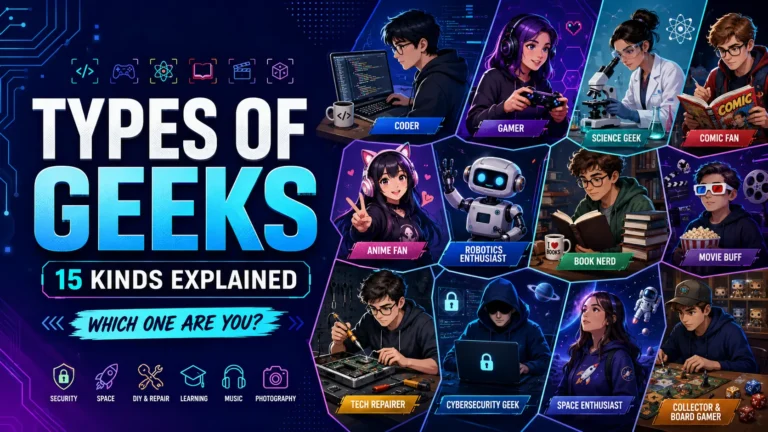

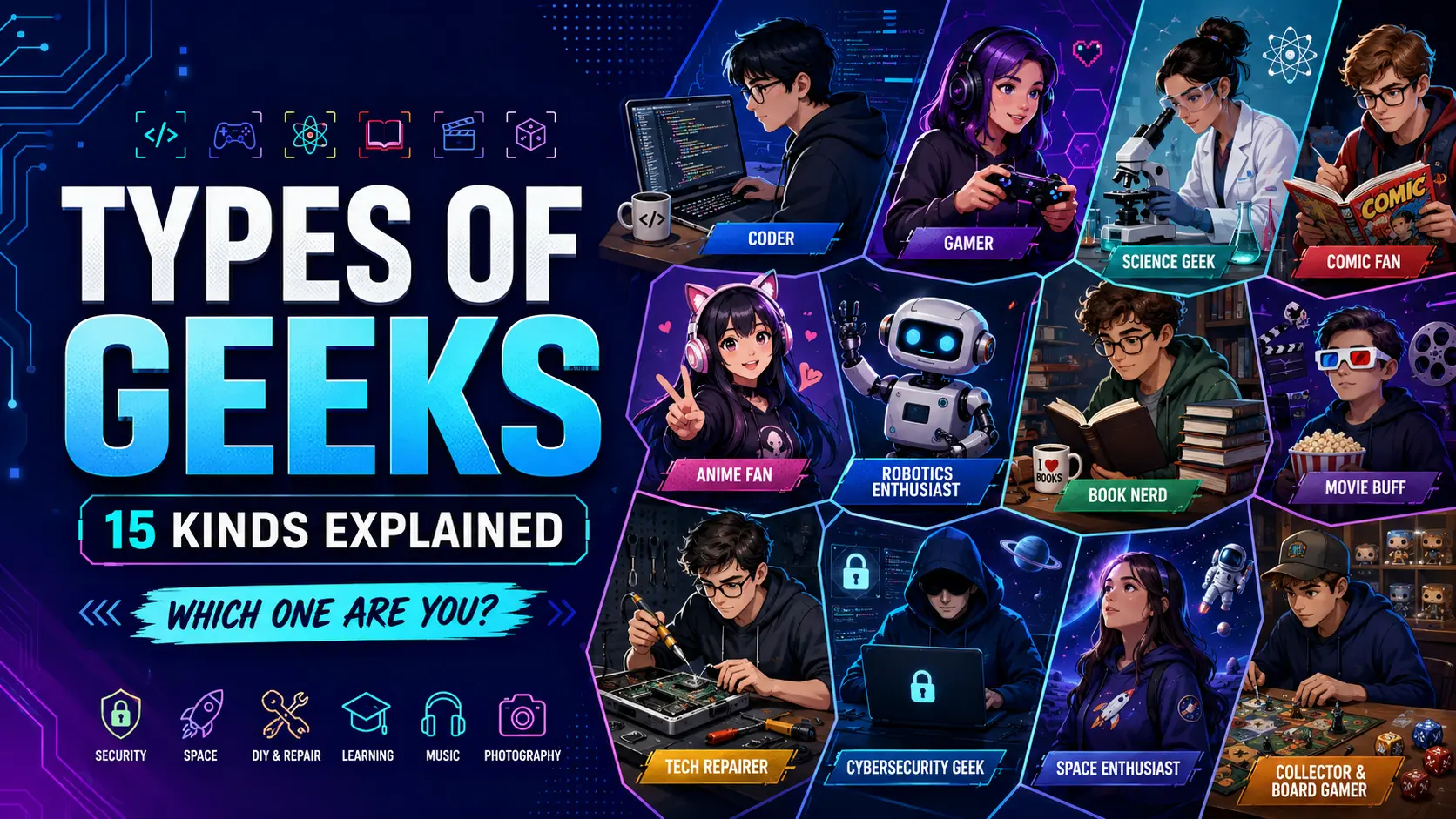
There is not just one kind of geek. “Geek” is an umbrella term, and underneath it sits a whole universe of specific passions. From the tech geek who upgrades their PC for fun to the anime geek who never misses a seasonal release, every geek is obsessed with something different.
In this guide we’ll walk through 15 types of geeks, what makes each one tick, and the tell-tale signs you belong to that group. By the end, you’ll probably recognize yourself in at least two or three of these geek categories, because most of us are a mix.
If you’re new to the whole idea, start with our guide on what a geek really is, then come back and find your tribe.
A geek type is simply the subject a geek pours their passion into. The core traits stay the same, deep interest, detailed knowledge, and a love of community, but the focus changes. A gaming geek and a history geek behave almost identically; they just aim that energy at completely different worlds.
Tech geeks live for gadgets, hardware, and the latest software. They are the friend everyone calls when a laptop dies, they read spec sheets for fun, and they are usually first in line to try a new phone or operating system. If you have ever upgraded a component just to see if it did run faster, you are a tech geek.
Gaming geeks are passionate about video games across every platform, console, PC, or handheld. They know the lore, follow the studios, debate frame rates, and treat their gaming setup like a personal shrine. For them, gaming is not just a hobby; it is a culture they are fully plugged into.
Comic book geeks know their issue numbers, variant covers, and decades of character history. They can explain exactly how a storyline in the comics differs from the movie version and they will happily do so. Collecting, reading, and debating canon is all part of the fun.
Science-fiction geeks are obsessed with the future, space travel, and “what if” worlds. Whether it is exploring distant galaxies or imagining how technology might reshape society, they love stories that push the boundaries of what is possible. Big franchises and obscure novels alike all earn their devotion.
Where sci-fi looks forward, fantasy geeks look toward magic, mythical creatures, and epic quests. They memorize maps of invented worlds, track family trees of fictional kingdoms, and dive deep into lore. A thick fantasy novel or a sprawling fantasy series is their happy place.
Anime geeks are devoted to Japanese animation and manga. They follow seasonal release schedules, have strong opinions on sub versus dub, and often get into cosplay and conventions. Their passion frequently spills into Japanese culture, language, and art as a whole.
Film geeks see movies as an art form, not just entertainment. They notice cinematography, study directors, and catch hidden references most viewers miss. Many collect physical media and can rank an entire filmography off the top of their head.
Science geeks want to understand how the universe actually works. Space, biology, physics, chemistry, they devour documentaries, follow research news, and love a good experiment. They’re the ones explaining black holes at the dinner table with genuine excitement.
Music geeks go far beyond just listening. They study genres, obsess over audio gear, collect vinyl, and dig into how records are produced. Ask one about their favorite album and you’ll get the full story behind every track.
Book geeks are voracious readers who treat their bookshelf like a trophy case. They annotate, collect special editions, join reading communities, and have opinions about every screen adaptation of their favorite novels.
History geeks are fascinated by the past, ancient civilizations, famous battles, and how we got to today. They visit museums for fun, binge historical documentaries, and can not resist dropping a “well, actually” fact at the perfect moment.
Math geeks find genuine beauty in numbers, patterns, and logic. Puzzles, proofs, and brain teasers are their idea of a good time. Where others see a tricky equation, they see a satisfying challenge waiting to be solved.
Coding geeks love building things with software. They automate boring tasks, contribute to open-source projects, and pick up new programming languages just for the fun of it. Give them a problem and they will instinctively want to write a script to fix it.
Tabletop geeks are all about board games, card games, and role-playing systems like Dungeons & Dragons. They host game nights, study rulebooks, and sometimes paint their own miniatures. For them, the best entertainment happens around a table with friends.
Auto geeks know engines, specs, and modifications inside out. They can identify a car by the sound of its engine, spend weekends in the garage, and follow the latest releases obsessively. Their passion blends mechanical skill with pure enthusiasm.
Definitely, and most geeks are. A single person might be a gaming geek and a tech geek and an anime geek all at once. These geek categories overlap constantly, because passion doesn’t stay in a neat box.
In fact, many of the best-known geek interests are deeply connected. A sci-fi geek often loves gaming. A comic book geek usually enjoys superhero films. The more you explore, the more your interests tend to multiply.
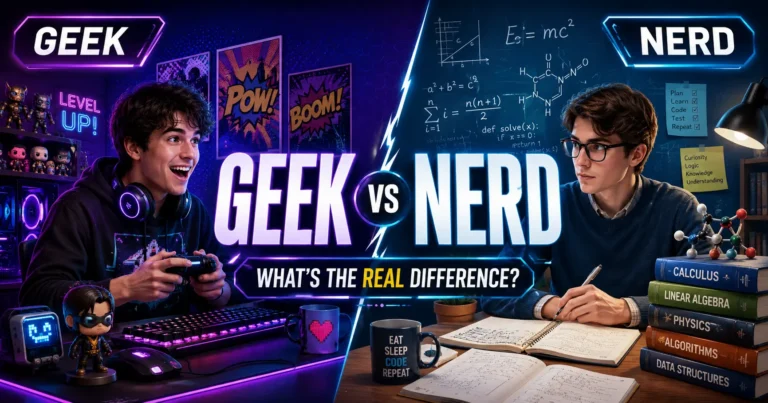
You might wonder where “nerds” fit into all this. The short version: geeks are defined by passion for these interests, while nerds lean more toward academic mastery of a subject. A science geek loves space documentaries; a science nerd might study astrophysics formally.
The two overlap heavily, and plenty of people are both. If you want the full breakdown, we cover it in detail in our geek vs nerd guide.
Once you know your type (or types), lean into it. Join communities, attend events, start a collection, or simply spend more guilt-free time on what you love. Your passion is a feature, not a flaw, and there is a whole world of people who share it.
Decades ago, being into something “geeky” could feel isolating, you might have been the only person in your town obsessed with a particular game or comic. The internet changed everything. Today, no matter how specific your interest, there’s a community out there for it: subreddits, Discord servers, YouTube channels, fan wikis, and local meetups.
This is exactly why geek categories have multiplied. Online spaces let people gather around incredibly narrow passions, from retro console collecting to a single long-running anime. Each community develops its own language, inside jokes, and experts. The result is that “geek” no longer means one thing, it is a thousand overlapping subcultures, each one welcoming people who care deeply about the same niche.
The 15 types above are the classics, but new kinds of geeks appear all the time. As technology and culture shift, fresh categories emerge, think AI geeks fascinated by machine learning, fitness geeks who track every workout metric, photography geeks chasing the perfect shot, or foodie geeks who treat cooking like a science.
The lesson? You do not have to fit a pre-made label. If there is a subject you obsess over, learn deeply, and love sharing, that is your geek type, even if it does not have a name yet.
Not sure where you land? Ask yourself a few simple questions:
Whatever answer keeps coming up, that is your geek type. And if several answers tie for first place, congratulations: you’re a multi-type geek, which is arguably the most fun kind to be.
There's no fixed number, "geek" covers any deep passion. This guide lists 15 of the most common types, including tech, gaming, comic book, sci-fi, anime, film, and science geeks, but you could create a geek category for almost any interest.
The most common are tech geeks, gaming geeks, comic book geeks, sci-fi and fantasy geeks, anime geeks, and movie geeks. These tend to have the largest communities and the strongest pop-culture presence.
Yes. Most geeks fit several categories at once, because related interests naturally overlap, like gaming, sci-fi, and tech often going hand in hand.
A geek type is built around passion for an interest (gaming, comics, anime), while a nerd is associated with academic, knowledge-driven focus. The two frequently overlap, and many people are both.