How to Fold a Pocket Square: 7 Folds, Step by Step
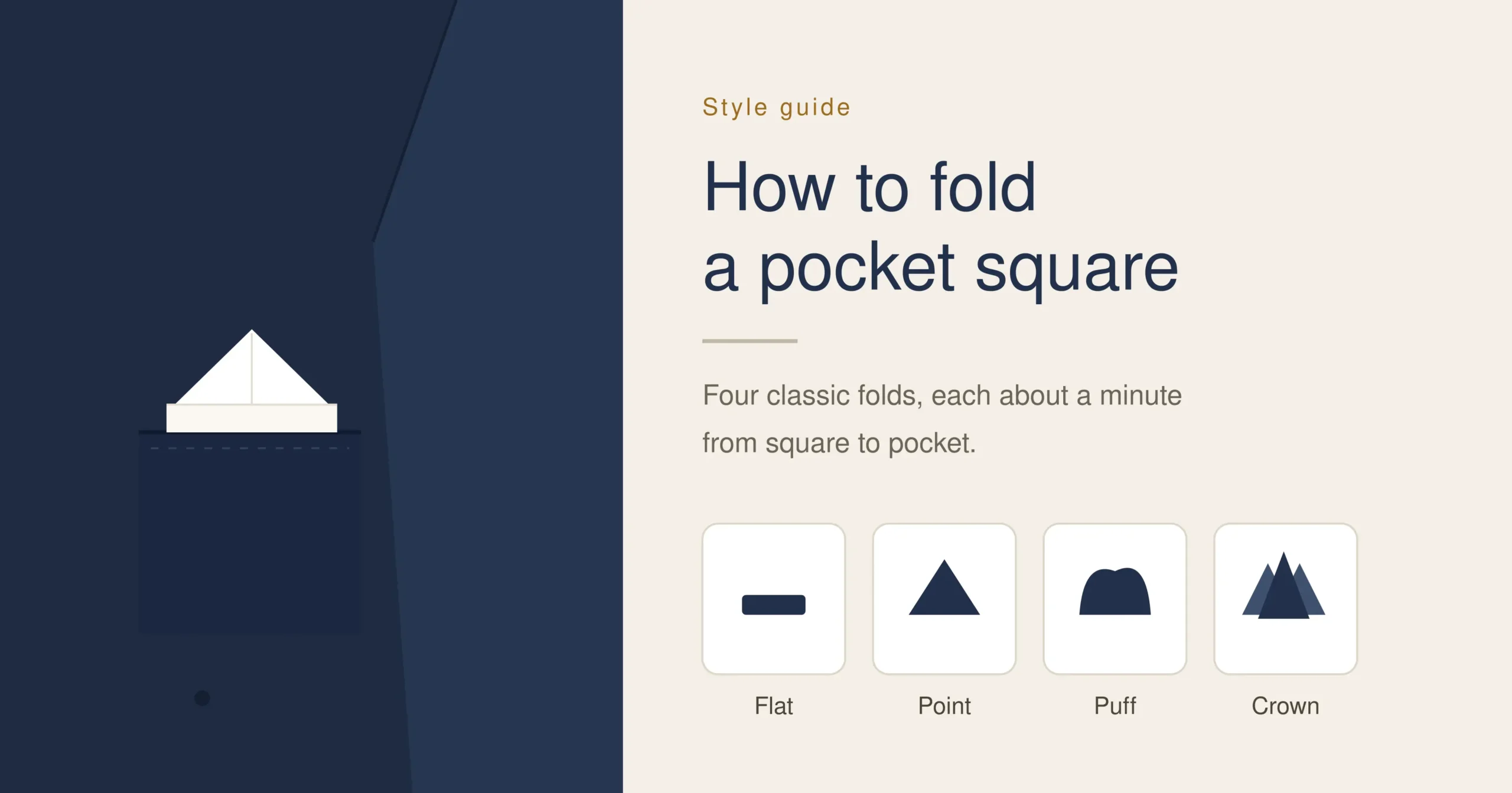
To fold a pocket square, lay it flat, choose a fold that suits the fabric, and insert it so it sits a quarter to a half inch above the pocket edge. Learning how to fold a handkerchief for a suit takes about two minutes per style once you know which fold your fabric can actually hold.
Fabric is the part most guides ignore. A crisp presidential fold works in linen and collapses in silk. This guide covers seven folds with numbered steps, which fabric each one needs, how far the square should sit above the pocket, and how to stop it sinking by the end of the evening.
Key Takeaways
- The presidential fold is the easiest and most formal. It takes three folds and works with any suit.
- Silk cannot hold sharp points without an insert. Use silk for puff folds and linen or cotton for pointed folds.
- Standard pocket squares run 12 x 12 inches to 17 x 17 inches. Larger squares suit bulky folds; smaller squares suit flat ones.
- A pocket square should sit a quarter to a half inch above the pocket for flat folds and up to one and a half inches for puffs and points.
- Never match your pocket square exactly to your tie. Matched sets read as rented formalwear. Pull a secondary colour from the tie’s pattern instead.
- White linen in a presidential fold is correct for black tie and safe for every other occasion.
What do you need before you fold a pocket square?
You need three things: a pocket square in the right fabric, a flat surface, and an iron. Ironing matters more than technique, because creases from storage show through every fold and no amount of adjustment hides them.
A pocket square is a decorative cloth folded into the breast pocket of a jacket, distinct from a handkerchief, which is a functional item kept in a trouser pocket. The two are not interchangeable in size or fabric.
Check the size first. Squares range from 12 x 12 inches to 17 x 17 inches. Silk squares tend toward the smaller end, linen and cotton toward the larger. A 12-inch silk square disappears into a deep breast pocket, and a 17-inch linen square creates visible bulk under a slim jacket.
Look at the edge. A hand-rolled edge has a soft raised border and adds body to puff folds. A machine-rolled hem lies flatter and suits pointed folds.
Iron on low heat with a pressing cloth for silk. Linen takes direct heat and a little steam. Cotton sits between the two.
Which pocket square fold should you choose?
Choose a flat fold for formal settings and a soft fold for relaxed ones. Pocket square fold styles fall into three families: flat folds with a straight top edge, pointed folds with visible peaks, and puff folds with gathered fabric.
| Fold | Difficulty | Best fabric | Formality | Time |
| Presidential | Easy | Linen, cotton | Highest | 30 seconds |
| Puff | Easy | Silk | Medium | 20 seconds |
| One point | Easy | Linen, cotton | High | 1 minute |
| Two point | Moderate | Linen, cotton | Medium-high | 2 minutes |
| Winged puff | Moderate | Silk, light cotton | Medium | 1 minute |
| Three point | Harder | Crisp linen | Medium | 3 minutes |
| Crown (four point) | Harder | Crisp linen | Medium-low | 3 minutes |
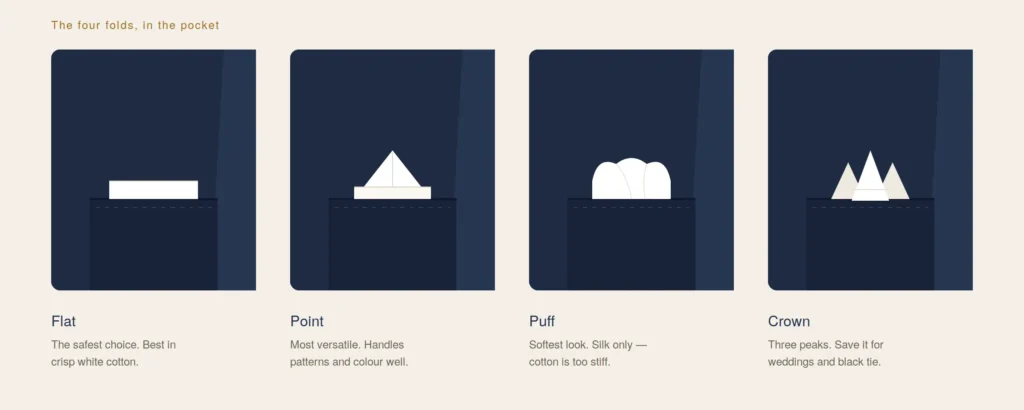
Match the fold to the occasion, not to your mood. Flat folds suit interviews, funerals and formal evening wear. Pointed folds suit weddings and business settings. Puff folds suit parties and anything where a strict jacket would look out of place.
Beginners should start with the presidential and the puff. Both are easy pocket square folds that forgive imprecision, and between them they cover roughly 80 percent of real occasions.
How do you fold a pocket square step by step?
Every fold starts the same way: lay the square flat, face down, on a clean surface. The instructions below assume that starting position throughout. Work through this pocket square folding guide in order if you are new to it, since each fold builds on the one before.
Presidential fold
The presidential fold produces a single straight horizontal line and is the most formal option available.
- Lay the square flat and fold it in half from left to right.
- Fold it in half again from bottom to top.
- Fold the bottom edge up until the height matches your pocket depth.
- Insert with the clean folded edge facing up and outward.
Puff fold
The puff fold produces soft gathered fabric with no defined edges. It suits silk better than any other fold.
- Lay the square flat and pinch the centre with two fingers.
- Lift the square so the fabric falls into natural folds.
- Run your other hand down the hanging fabric to gather it into a loose column.
- Fold the bottom third under and insert with the gathered top showing.
One point fold
The one point fold produces a single peak. It reads as formal without the severity of a straight edge.
- Lay the square as a diamond, with one corner pointing toward you.
- Fold the bottom corner up to meet the top corner, forming a triangle.
- Fold the left corner in toward the centre, then the right corner over it.
- Insert with the single point facing up.
Two-point fold
The two-point fold produces two staggered peaks and works well at weddings.
- Lay the square as a diamond.
- Fold the bottom corner up, but stop about an inch to the left of the top corner so two separate points appear.
- Fold the left side in toward the centre, then the right side over it.
- Insert with both points showing above the pocket.
Three-point fold
The three point fold produces a stepped row of peaks and needs crisp fabric to hold its shape.
- Lay the square as a diamond and fold the bottom corner up an inch to the left of the top, creating two points.
- Take the left corner and fold it up and to the right, forming a third point beside the other two.
- Fold the remaining left edge behind the square.
- Fold the right edge behind and insert with all three points visible.
Crown fold (four point)
The crown fold produces four peaks in a fan and is the least formal of the pointed folds.
- Follow the three-point fold through step two.
- Take the right corner and fold it up and to the left, creating a fourth point.
- Fold both remaining side edges behind the square.
- Insert with all four points fanned above the pocket.
Winged puff fold
The winged puff produces a rounded center with two soft peaks and sits between a puff and a pointed fold in formality.
- Lay the square flat and pinch the centre.
- Lift and gather as you would for a standard puff.
- Fold the gathered column in half so two soft wings rise on either side.
- Tuck the tail under and insert with the wings showing.
How does fabric change which fold works?
Fabric determines whether a fold holds. Silk slips against itself and cannot maintain a sharp crease without help. Linen holds a fold indefinitely. Cotton sits between them.
A crease is only permanent when the fibres compress and stay compressed, which is why plant fibres like linen and cotton hold folds and protein fibres like silk do not.
| Fabric | Holds points | Holds flat edge | Best folds | Weakness |
| Linen | Excellent | Excellent | Presidential, all pointed folds | Looks stiff in a puff |
| Cotton | Good | Good | Presidential, one and two point | Less sheen than silk |
| Silk | Poor | Poor without insert | Puff, winged puff | Slips out of pointed folds within an hour |
| Wool | Moderate | Moderate | Puff, one point | Bulky in a slim pocket |
The most common mistake is buying a silk square, folding it presidential-style for a wedding, and watching it slump into the pocket by the end of the ceremony. The fold is not wrong. The fabric cannot hold it.
Two workarounds exist. Use a pocket square holder, which is a flat plastic or card insert that supports the fold from behind. Or fold the silk into a puff, which requires no structure at all and is what silk is genuinely good at.
How do you put a pocket square in a jacket?
Insert the pocket square gently, adjust the height with small pulls rather than pushes, and check it in a mirror from three feet away. The breast pocket on most jackets is a welt pocket roughly four to five inches wide and three inches deep.
Height rules by fold type:
- Flat folds: a quarter to a half inch above the pocket edge
- Pointed folds: three quarters of an inch to one and a half inches
- Puff folds: one to one and a half inches
Too much fabric showing reads as costume. Too little disappears entirely, and from across a room the pocket looks empty.
Fold any excess fabric under before inserting rather than pushing it deeper. A square jammed into a shallow pocket bulges the jacket front, which is visible from the side even when the fold itself looks correct.
Sit down and stand up once after inserting. Movement reveals whether the square will hold, and it is better to discover a slipping fold at home than at the venue.
Check the mirror at conversational distance. Details that look precise at arm’s length often read as fussy from six feet away, which is the only distance that matters.
How do you stop a pocket square from sinking?
Stop a pocket square sinking by folding a supporting tail beneath the visible section, or by using a dedicated insert. Sinking happens when the fabric has nothing to rest against inside a deep pocket.
Four fixes, ranked by how well they hold:
- Use a pocket square holder. A thin card or plastic insert clips the square and holds the height. It is the only method that survives a full day reliably.
- Fold a tail. Leave two to three inches of fabric folded back and forth beneath the visible part, creating a concertina that wedges against the pocket.
- Add a tissue. Place a folded tissue at the bottom of the pocket to raise the base. Free, invisible, effective for a few hours.
- Choose a larger square. A 16-inch square has enough body to support itself where a 12-inch square does not.
Silk needs support more than any other fabric. Linen in a presidential fold rarely sinks at all, because the compressed fold has enough rigidity to brace itself.
Avoid pins and tape. Both leave permanent marks on silk, and a visible pin through a breast pocket undoes the effect entirely.
Should your pocket square match your tie?
No. An exact match between pocket square and tie reads as a pre-packaged set and is the single most recognizable styling error in menswear. Coordinate instead of matching.
Three approaches that work:
- Pull a secondary colour. Take a minor colour from the tie’s pattern and use it as the pocket square’s main color.
- Contrast the texture. A silk tie with a linen square, or a knit tie with a silk square, creates visual interest without colour matching.
- Default to white. A white linen square works with every tie ever made and is never wrong.
A pocket square coordinates with the whole outfit rather than with any single item, which includes your shirt, jacket, and the setting.
Patterns can sit together if their scale differs. A wide-striped tie pairs cleanly with a small-dotted square. Two patterns at the same scale compete and look accidental.
You can wear a pocket square without a tie. An open-collar shirt with a blazer and a linen square is a standard warm-weather combination, and the square becomes the only formal element rather than one of several.
Which pocket square suits each occasion?
Match formality to setting. The safest option in any uncertain situation is white linen in a presidential fold, which has never been inappropriate at any event.
| Occasion | Fold | Fabric and colour |
| Black tie | Presidential | White linen or silk |
| Wedding guest | Two points or puffs | Colour drawn from the tie |
| Job interview | Presidential | White or pale grey linen |
| Funeral | Presidential | White linen only |
| Business meeting | One point | White or subtle pattern |
| Cocktail party | Puff or winged puff | Silk, any colour |
Weddings deserve one specific note. Groomsmen often wear matching squares by design, which is the one situation where a matched set is correct, because it signals a role rather than a lack of taste.
Keep it plain for funerals. White linen, flat fold, nothing else.
For interviews and industry events, the square should register as neat rather than noticeable. The same restraint that serves you when building professional relationships in a new field applies to what you wear while doing it.
Who this guide is not for. If you are wearing a uniform, military dress, or academic regalia, follow the relevant dress regulations instead, since those specify pocket square use precisely and override general menswear convention.
What are the most common pocket square mistakes?
The most common mistake is choosing a fold the fabric cannot hold. Every other error follows from a small number of predictable habits.
| Mistake | What it looks like | Fix |
| Matching the tie exactly | Rented formalwear | Pull a secondary colour from the tie |
| Too much fabric showing | Costume, not tailoring | Reduce to the height range for that fold |
| Skipping the iron | Storage creases cutting across the fold | Press before every wear |
| Silk in a pointed fold | Collapse within the hour | Switch to a puff or add an insert |
| Pushing the square deeper | Bulging jacket front | Fold the excess under instead |
Two habits cause most of the rest. People fold at the venue rather than at home, which guarantees a rushed result. And people check the mirror at arm’s length, where a fold looks precise but reads as fussy from across a room.
Store squares flat or loosely rolled rather than folded in a drawer. Permanent creases form along the same lines over months, and those lines rarely align with the fold you want.
Frequently asked questions
What is the easiest pocket square fold? The presidential fold. It takes three folds, produces a straight horizontal edge, and works with any fabric that holds a crease. The puff fold is equally easy and better suited to silk.
How big should a pocket square be? Between 12 x 12 inches and 17 x 17 inches. Choose smaller squares for flat folds and shallow pockets, larger squares for puffs and pointed folds that need more fabric.
Can I use a handkerchief as a pocket square? Technically yes, but handkerchiefs are usually plain white cotton with visible machine hems and read as functional rather than decorative. A dedicated pocket square has finished edges and better drape.
Should the pocket square match my shirt? No. A square that matches the shirt exactly disappears against it. Choose a contrasting tone, or use white against a coloured shirt.
How do I iron a pocket square without damaging it? Use low heat and a pressing cloth for silk. Linen tolerates direct heat and steam. Iron from the centre outward and avoid pressing hard on rolled edges, which flattens the border permanently.
Can I wear a patterned pocket square with a patterned suit? Yes, provided the pattern scales differ. A checked suit works with a small-dotted square. Two patterns of similar scale compete and look unplanned.
How far should a pocket square stick out? A quarter to a half inch for flat folds, three quarters to one and a half inches for pointed folds, and one to one and a half inches for puffs. Check the result from three feet away.