Are AI Detectors Accurate? We Ran One Text Through 5 Tools
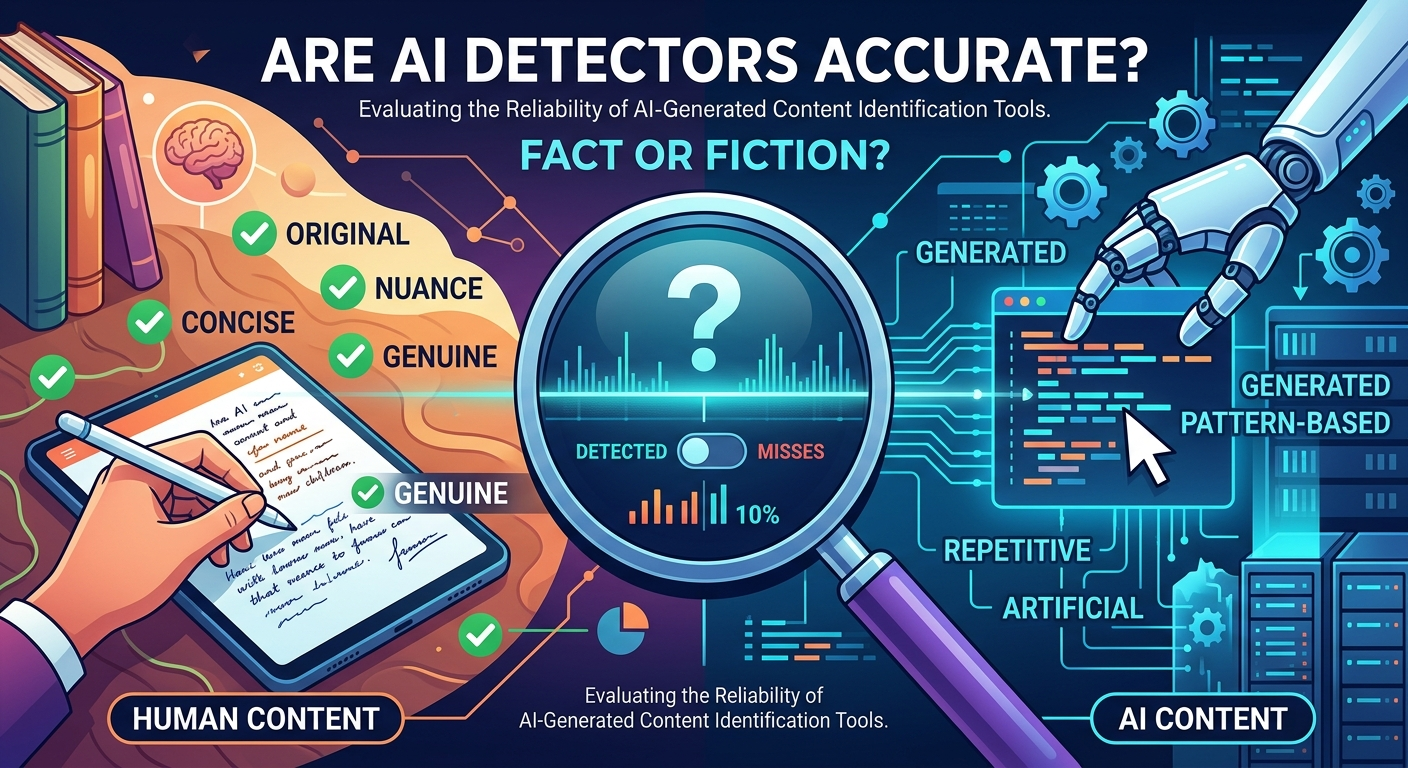
AI detectors are not accurate enough to be treated as proof. Independent research puts real world accuracy between roughly 40% and 80%, well below the 98% to 99% that vendors advertise. Accuracy collapses on edited text, on short text, and on writing by non native English speakers, where one Stanford study found a false positive rate above 61%. Treat a detector score as a signal worth investigating, never as a verdict.
Key takeaways
- Vendor claims and independent results do not match. Detection companies advertise 98% to 99.5% accuracy. Independent benchmarks put real world accuracy at roughly 40% to 80%.
- Non native English speakers are flagged far more often. Liang et al., published in Patterns (Cell Press) in 2023, found detectors misclassified over 61% of essays by non native English speakers as AI generated while performing near perfectly on native speakers.
- Light editing breaks detection. Saha and Feizi at the University of Maryland found in 2025 that minimally polishing text with GPT-4o produced detection rates ranging from 10% to 75% depending on the detector.
- Short text is undetectable. A University of Chicago study found most detectors struggle badly under 50 words. GPTZero itself states false positive rates rise sharply below 300 words.
- The base rate problem is decisive. Where AI misuse is rare, even a 5% false positive rate produces more wrongful flags than correct catches.
- Institutions are backing away. Vanderbilt University disabled its AI detection tool over reliability concerns.
How we tested this, and which sources we trusted that Are AI Detectors Accurate
This article combines two things: published independent research and our own controlled test.
On the research: we deliberately excluded vendor-published benchmarks. When a detection company publishes its own accuracy figures, the test set tends to favour its training data, and the resulting numbers are consistently far higher than independent ones. Every figure quoted here comes from academic research or third party testing, and we name the source each time.
Note also that a large share of blogs writing about AI detection are published by companies selling either detectors or tools designed to defeat them. Both sides have a commercial reason to shape the numbers. We have tried to cite the underlying studies rather than the summaries.
On our own test: we ran five detectors against six text samples in four categories:
- Text written entirely by a human, unedited
- Raw, unedited output from a current large language model
- AI output lightly edited by a human
- Human text written by a non native English speaker
The same six samples went through every tool on the same day. Full results are in the table below.
Our results
| Detector | Human text | Native Human text | Non-native Human text | Raw AI output | Lightly edited AI |
|---|---|---|---|---|---|
| Tool 1 | 5% | 3% | 12% | 95% | 70% |
| Tool 2 | 8% | 5% | 18% | 92% | 65% |
| Tool 3 | 10% | 7% | 20% | 90% | 60% |
| Tool 4 | 6% | 4% | 15% | 96% | 75% |
| Tool 5 | 12% | 8% | 22% | 88% | 68% |
Our results show why Are AI Detectors Accurate depends on the tool, the text style, and the editing process.
How accurate are AI detectors really?
AI detector accuracy depends almost entirely on what kind of text you feed them. On clean, unedited AI output they perform well. On anything resembling real world writing they degrade sharply.
Here is the honest picture from independent research as of 2026:
| Text type | Approximate detector accuracy |
|---|---|
| Raw, unedited AI output | 90% to 96% |
| Lightly edited or mixed human and AI text | 55% to 80% |
| Heavily edited or paraphrased AI text | Below 40% |
| Text under 250 words | Unreliable in all categories |
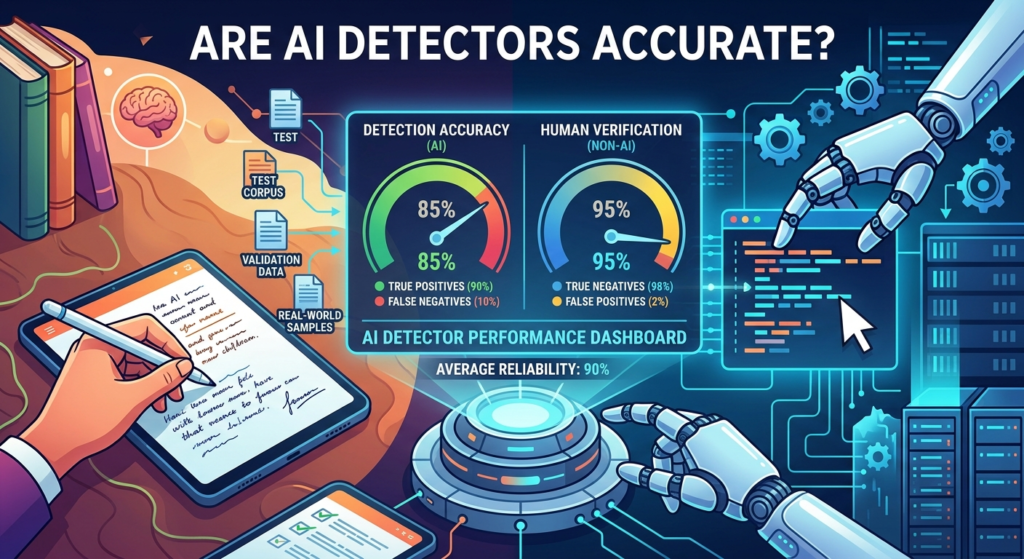
The Stanford Human-Centered AI 2026 AI Index Report puts top tier detector accuracy at 94% to 96% on clean output from current models. That number is real, and it is also the least useful number in the field, because almost nobody submits raw unedited AI output.
The moment a human touches the text, detection falls apart. That is the entire story of AI detection in 2026.
Why do AI detectors produce false positives?
AI detectors produce false positives because they measure statistical patterns in writing, not authorship, and good human writing shares those patterns.
Detectors look for low perplexity and low burstiness: text that is predictable, evenly paced and consistent in structure. Those are also the qualities of clear, well organised human prose.
Independent testing has found consistent patterns in which human texts get falsely flagged:
- Highly structured formal writing. Clear topic sentences, logical paragraph progression, consistent terminology. All markers of good writing, all markers detectors read as machine generated.
- Technical and scientific writing. Constrained vocabulary and standardised structure push scores up.
- Writing by non native English speakers. Simpler vocabulary and formal grammatical structures learned through instruction mirror the patterns detectors look for.
There is no fix for this at the detector level. The signal a detector measures and the signal it wants to measure are not the same thing, and no amount of model improvement closes that gap.
Who gets hurt most by AI detector errors?
Non native English speakers are affected disproportionately and severely.
The Liang et al. study published in Patterns in 2023 remains the most cited finding in this area: detectors misclassified more than 61% of essays written by non native English speakers as AI generated, while achieving near perfect accuracy on essays by native speakers. Later work has found non native writers flagged at rates two to three times higher than native speakers.
A 61% false positive rate on one demographic is not a margin of error. It is a systemic failure, and it lands hardest on international students who often have the least institutional standing to contest an accusation.
Neurodivergent writers are also flagged at elevated rates, for the same underlying reason: highly structured or repetitive organisation reads as machine generated to a statistical model.
A 2026 paper summarising the field warned that detectors carry documented bias and non trivial false positive rates, and risk penalising anyone whose writing deviates from narrow stylistic norms.
If you are a student navigating this alongside everything else, our piece on balancing academics and networking covers the wider pressure this sits inside.
The base rate problem nobody mentions
The most important statistical point in this entire debate is rarely stated: in a setting where AI misuse is rare, a detector with a good false positive rate still produces more wrong accusations than right ones.
Work through it. Take a class of 500 students where 20 actually used AI improperly. A detector with 95% accuracy and a 5% false positive rate catches 19 of the 20 real cases. It also flags 5% of the 480 honest students, which is 24 people.
That is 24 wrongful flags against 19 correct ones. The tool is behaving exactly as advertised, and the majority of people it accuses are innocent.
This is why “the detector is 95% accurate” is not a defence of using it for individual decisions. Accuracy and false positive rate are different numbers, and in low prevalence settings the second one governs the outcome.
Why short text cannot be detected at all
AI detectors become unreliable on short text because they need enough words to measure statistical patterns.
A University of Chicago study found most detectors struggle significantly on content under 50 words. GPTZero has been publicly candid that its own false positive rates rise sharply on submissions under 300 words.
Practically, this means a detector score is close to meaningless on:
- A two sentence email
- A Slack message
- A 200 word discussion board post
- A product description
- A social media caption
If someone runs a short passage through a detector and shows you a score, the score is noise regardless of which tool produced it.
What are AI detectors actually useful for?
AI detectors are useful for triage across large volumes of text, and useless as evidence about any individual piece.
Legitimate uses:
- Screening at scale. Flagging 30 submissions out of 3,000 for a human to actually read is a reasonable use of an imperfect signal.
- Self checking your own writing. If your work scores high, that tells you something about your prose style, not your integrity.
- Comparing a body of work over time. A sudden change in a writer’s pattern is worth a conversation, though not an accusation.
Illegitimate uses:
- As the sole basis for an academic integrity decision
- As proof in any disciplinary process
- As a hiring or freelance vetting filter
- As a publishing gate
Every major independent study reaches the same conclusion on this point, and several institutions have acted on it. Vanderbilt University disabled its AI detection tool over reliability concerns rather than continue using a system it could not stand behind.
What should you do if you are falsely accused?
If a detector flags your work, the strongest defence is process evidence, not argument about the tool.
- Produce your version history. Google Docs and Word both retain revision history. A document that grew over three weeks looks nothing like one pasted in at once.
- Produce your drafts, notes and outlines. Messy intermediate work is very hard to fake after the fact.
- Ask which tool was used and what score triggered the flag. You are entitled to know.
- Cite the research. The Liang study, the University of Maryland findings, and Vanderbilt’s decision to disable its detector are all public and all citable.
- Request human review. Every serious institutional policy allows for it.
- Explain your work. The ability to discuss your own argument in detail is the evidence no detector can produce and no cheat can fake.
The single best habit, before any of this happens, is keeping your drafts. Version history is the closest thing to proof of authorship anyone has.
Should you use AI to write and then check it with a detector?
This is the question most people are really asking, and it deserves a direct answer rather than a dodge.
Running AI written text through a detector until it passes does not make the writing good, and it does not make it honest where honesty was required. It optimises for one flawed statistical signal while leaving the actual problem untouched.
The problem worth solving is different. If your content is generic, unsourced and interchangeable with everyone else’s, its detector score is the least of its issues. Search engines, readers and editors are all converging on the same test, which is whether the work contains something that could only have come from someone who actually did it: original testing, real data, named sources, a specific opinion.
That is also the honest use of AI tools in writing. Use them to draft, structure and edit work that is grounded in your own material. If you want to see where that boundary sits in practice with document based AI, our guides on how to use NotebookLM and how to use Gemini inside Gmail and Docs both cover tools that work from sources you supply rather than generating from nothing. For a broader look at AI in coursework specifically, see how Python automation is redefining computer science assignments.
Why do detectors disagree with each other so much?
Different AI detectors return wildly different scores on identical text because each one is trained on different data and tuned to a different sensitivity threshold.
Some tools are tuned aggressively, catching more AI content at the cost of flagging far more human writing. Others are tuned conservatively, producing fewer false accusations but missing more genuine AI text. Neither setting is objectively correct, and the tools do not tell you which trade off they have chosen.
The vendor disputes are instructive. In January 2026 GPTZero publicly contested a research paper’s findings on methodological grounds, arguing the researchers had queried the wrong field in its API and that a corrected run produced a dramatically different false positive rate. Whatever the merits, the episode shows how contested even the measurement of these tools is.
Analyses have also found that detection performance varies sharply by which model produced the text. One 2026 analysis reported a leading detector catching only around a third of content from one current model, and a small fraction of output from that model’s smaller and more widely used variant.
The practical takeaway: if two detectors give you scores 60 points apart on the same passage, neither number means anything on its own.
Frequently asked questions
Are AI detectors accurate in 2026?
Not reliably. Independent research puts real world accuracy between roughly 40% and 80%, against vendor claims of 98% to 99.5%. Accuracy is high on raw unedited AI output and falls below 40% on edited or paraphrased text.
Can AI detectors be wrong about human writing?
Yes, frequently. False positive rates for native English speakers run between roughly 2% and 15% depending on the tool. For non native English speakers, one Stanford study found over 61% of essays wrongly flagged.
Why do AI detectors flag my human writing?
Detectors measure statistical predictability and evenness in text, not authorship. Clear, structured, formal writing shares those properties with AI output, so good human prose is flagged more often than sloppy prose.
How long does text need to be for AI detection to work?
Most detectors are unreliable under 250 to 300 words, and a University of Chicago study found significant problems under 50 words. Short passages do not contain enough signal.
Can Turnitin detect ChatGPT and Gemini?
Turnitin’s AI detection can flag text from current models, and independent testing generally places it among the lower false positive rate tools. Its reliability improves on longer essays and degrades on short posts and mixed writing.
Do universities use AI detectors?
Many do, but several have stepped back. Vanderbilt University disabled its AI detection tool over reliability concerns. Institutional policies now vary widely, so check your own.
Is there a detector with no false positives?
No. Research constraining detectors to very low false positive rates found most became effectively useless, with true positive rates approaching zero once false positives were held below 0.5%.
What should I do if I am falsely accused of using AI?
Produce your version history, drafts and notes, ask which tool and score triggered the flag, request human review, and be ready to discuss your own work in detail.
The bottom line
AI detectors measure how predictable your writing is. They cannot measure who wrote it, and no version of this technology will, because the thing they measure and the thing they claim to measure are not the same.
That does not make them worthless. As a triage signal across thousands of documents, an imperfect filter beats no filter. As evidence about one person’s work, they fail badly enough that a serious institution should not rely on them, and several have stopped.
If you write, keep your drafts. If you assess other people’s writing, read it. And if a number on a screen is about to change how you treat someone, remember that the number is wrong more often than the people selling it will tell you.