How to Remove a Stripped Screw: 8 Methods, Least Destructive First
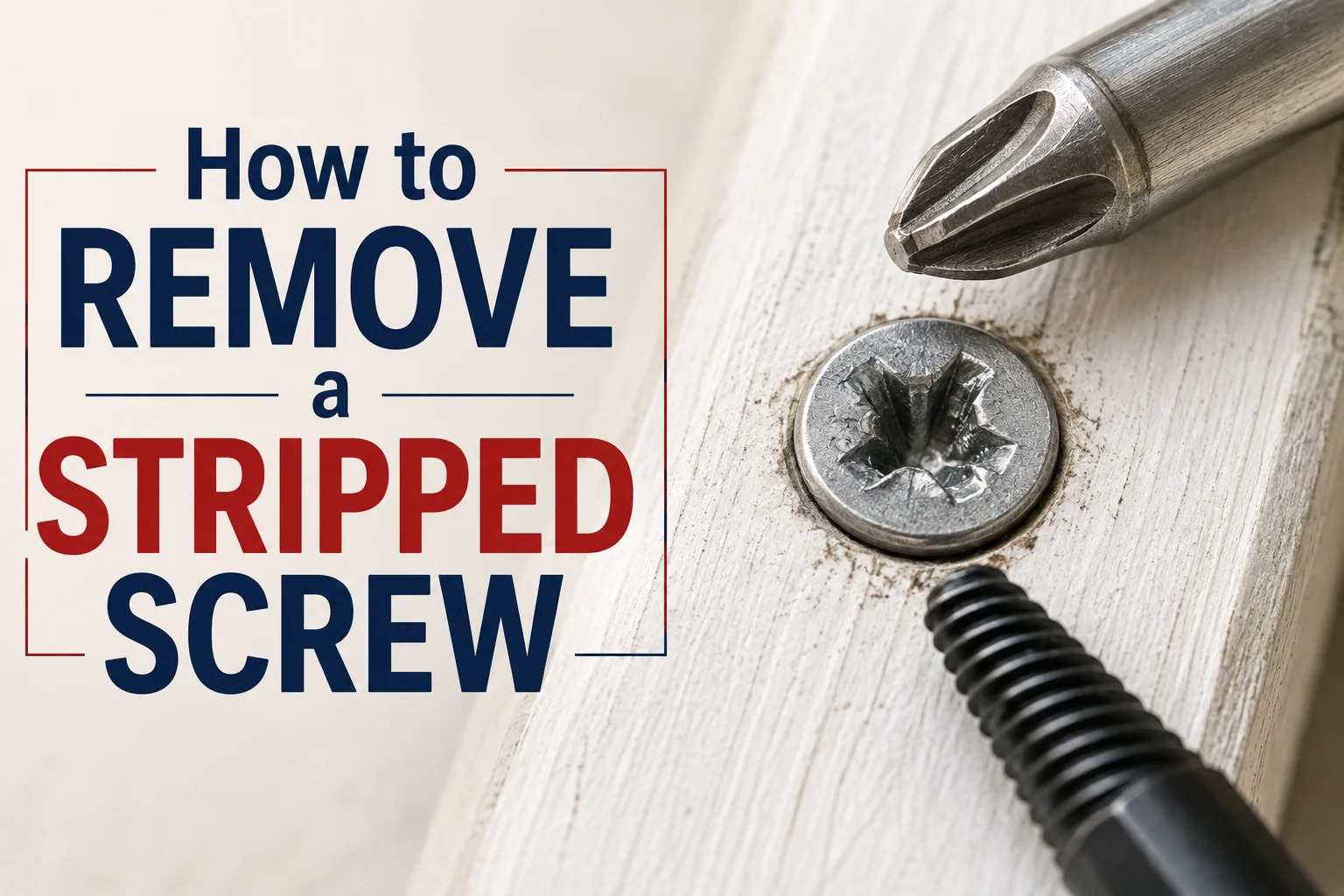
To learn how to remove a stripped screw, start by pressing a wide rubber band into the damaged head, then seat your screwdriver firmly and turn slowly with strong downward pressure. If that does not work, try abrasive paste, locking pliers, cutting a new slot, and finally a screw extractor.
Order matters more than technique. Every method below damages the screw head a little more than the one before it, so starting with an extractor when a rubber band would have worked leaves you with fewer options if it goes wrong. This guide covers the full escalation ladder, the differences for wood, metal, and electronics, and the one mistake that causes most stripped screws in the first place.
Key Takeaways
- Downward pressure matters more than torque. Aim for roughly 80 percent of your effort pushing down and 20 percent turning.
- A wide rubber band placed between the driver and the screw head fills the damaged recess and solves a large share of mildly stripped screws.
- Valve grinding compound, sold for about $8, dramatically increases bit grip and is the standard trick machinists use before reaching for any extractor.
- Left-hand drill bits cut counterclockwise, which often backs a screw out on its own before an extractor is needed.
- Screw extractors are hardened and brittle. A snapped extractor inside a screw requires a carbide bit to remove and is far worse than the original problem.
- Most stripped cross-head screws on Japanese electronics, cameras and motorcycles were stripped by a Phillips driver used on a JIS screw. The two heads look almost identical and are not interchangeable.
Why do screws strip in the first place?
Screws strip when the driver bit slips out of the recess under load, a process called “cam-out,” which grinds away the edges that transmit torque. Three causes account for nearly all of it: the wrong bit size, insufficient downward pressure, and using a Phillips driver on a JIS screw.
JIS is the Japanese Industrial Standard cross-head screw, which has a slightly different recess geometry from a Phillips screw despite looking nearly identical. A Phillips bit sits shallow in a JIS recess and cams out under load, chewing the head immediately.
JIS screws appear throughout Japanese cameras, motorcycles, bicycles, appliances and electronics. Many carry a small dot or dimple stamped beside the cross. A JIS driver set costs around $15 and eliminates a whole category of stripped screws permanently.
Two other habits cause the rest:
- Bit too small. A number 1 Phillips in a number 2 recess contacts only the innermost edges and destroys them.
- Power drill on high speed. Drills spin faster than the bit can stay seated. Use a hand driver, or a drill on its lowest clutch setting.
Phillips heads were designed to cam out deliberately, as a crude torque limiter for early assembly lines. That design intent is why they strip so readily under hand tools.
What should you try first?
Start with the least destructive method and stop the moment the screw moves. Each step down this ladder removes more material from the head, which narrows your options if the attempt fails.
| Step | Method | Damage caused | Success rate on mild stripping |
| 1 | Rubber band | None | High |
| 2 | Abrasive paste or friction drops | None | High |
| 3 | Larger or different bit, JIS driver | Minimal | Moderate |
| 4 | Locking pliers on the head | Marks the head | High if head protrudes |
| 5 | Hand impact driver | Minimal | Moderate to high |
| 6 | Cut a slot | Destroys the cross recess | High |
| 7 | Screw extractor | Drills into the head | Moderate |
| 8 | Drill out entirely | Destroys the screw | Last resort |
Before any of them, check two things. Confirm the screw is not reverse-threaded, which is common on some machinery and left-side bicycle pedals. And confirm nothing is holding it, since a screw fighting a thread locker or corrosion needs heat or penetrating oil rather than more force.
Give penetrating oil time to work on any metal-to-metal joint. Fifteen minutes minimum, longer for rust. Rushing this step is what turns a stuck screw into a stripped one.
How to Remove a Stripped Screw with a Rubber Band?
Place a wide flat rubber band over the screw head, press your screwdriver firmly into it, and turn slowly. The rubber fills the damaged recess and grips the remaining edges, which is often enough on its own.
- Choose a wide, flat band. A thick elastic band or a cut section of bicycle inner tube works better than a thin round one.
- Lay it flat across the screw head, covering the whole recess.
- Seat the screwdriver hard into the band and the recess. Push before you turn.
- Turn slowly and steadily. Sudden force tears the rubber.
Use your body weight rather than your wrist. Stand over the screw if the position allows, and push down through your shoulder while turning. Steel wool packed into the recess works as a substitute, though it is messier and less effective.
This method fails once the recess is fully rounded out, because there are no remaining edges for the rubber to bear against. If the driver spins freely with the band in place, move to the next step rather than repeating it.
How to Remove a Stripped Screw without a drill?
Three methods need no power tools: abrasive paste for grip, locking pliers for a protruding head, and a hand impact driver for stubborn screws. All three work in confined spaces where a drill will not fit.
Abrasive paste. Dab valve grinding compound or a purpose-made friction additive into the recess, then seat the bit and turn. The grit bites into both surfaces and increases friction substantially. Valve grinding compound costs around $8 for a tube that will last years. Products sold as friction drops for this exact purpose work on the same principle.
Locking pliers. If any part of the head sits above the surface, clamp locking pliers onto it as tightly as they will go and turn the pliers. This is the highest-success method available when the head protrudes even a millimetre.
Hand impact driver. A manual impact driver converts a hammer blow into a sharp rotational jolt while pressing the bit hard into the recess. The impact seats the bit and breaks the screw loose in the same motion. It is the tool professional mechanics reach for on seized fasteners, and it costs $25 to $50.
Rubber cement is a slower option. Apply a small amount, insert the bit, and let it cure for 10 to 15 minutes before turning. It bonds the bit to the head temporarily.
How do you cut a slot in a stripped screw?
Cut a straight slot across the screw head with a rotary tool and a thin cutting disc, then remove the screw with a flathead screwdriver. This converts a ruined cross-head screw into a working slotted one.
- Fit a thin abrasive cutting disc to a rotary tool such as a Dremel, or use a hacksaw blade for a screw in an open position.
- Put on eye protection. Cutting discs shatter, and they throw metal particles.
- Cut a single straight slot across the full width of the head, deep enough to take a flathead blade but not so deep that the head weakens.
- Protect the surrounding surface with masking tape or a thin metal shim.
- Seat a wide flathead screwdriver that fills the slot end to end and turn with heavy downward pressure.
Match the screwdriver to the slot. A blade narrower than the slot concentrates force at the centre and will strip the new slot as readily as the old recess.
This method works well on screws with an exposed head and poorly on countersunk screws, where the recess sits below the surface and the cutting disc cannot reach without damaging the material around it.
How do you use a screw extractor set?
A screw extractor cuts into the screw head with a reverse-threaded tip that bites harder as you turn counterclockwise. Most sets are double-ended: a burnishing end to prepare a hole, and an extraction end to grip and back the screw out.
- Fit the burnishing end into a drill and set the drill to reverse.
- Run it into the centre of the screw head at low speed with firm pressure, cutting a shallow tapered recess.
- Flip the bit to the extraction end.
- Seat it in the new recess and run the drill in reverse at the lowest speed available.
- Increase downward pressure as it bites. The reverse thread tightens its grip as it turns.
- Back the screw out completely rather than stopping partway.
Go slowly and keep pressure steady. Speed generates heat, and heat hardens the surrounding steel.
A hard warning. Extractors are made from hardened, brittle steel. Too much side load or torque snaps the tip off inside the screw, and a broken extractor is harder than the screw around it. Removing one requires a solid carbide bit or professional machining. If an extractor starts to flex or bind, stop.
How do left-hand drill bits remove screws?
Left-hand drill bits cut counterclockwise, in the same direction you need the screw to turn. Run in reverse, the bit frequently grips the screw and backs it out before any cutting is complete.
Start with a small bit, around one sixteenth of an inch, centred on the screw head. Use low speed and firm pressure. Many screws simply unwind themselves within a few seconds.
This is worth trying before a dedicated extractor. Left-hand bits are cheaper, less brittle, and they leave a clean pilot hole for an extractor if the screw does not come free.
How do you remove a stripped screw from wood?
Work through the standard ladder first, then use the fact that wood is softer than the screw. If the head is exposed, locking pliers usually win. If not, you can cut away wood around the screw.
For a screw sunk flush or below the surface:
- Try the rubber band and abrasive paste methods first.
- Use a plug cutter or a drill bit slightly wider than the screw head to bore a shallow recess around the head, exposing enough shank to grip with pliers.
- Grip and turn the exposed shank with locking pliers.
- Fill the hole afterwards with a wooden dowel and wood glue, cut flush once dry.
Screws in hardwood often bind because the pilot hole was undersized. Applying a little wax or soap to the threads of the replacement screw prevents a repeat.
If the screw must come out and nothing works, drill it out with a bit matched to the shank diameter, then plug and re-drill. Wood is forgiving, which makes this a reasonable last resort rather than a disaster.
The same hand tools that handle this kind of repair cover most outdoor jobs too, including the post-hole work in our guide to installing a mailbox to USPS specification.
How to Remove a Stripped Screw from metal?
Address what is holding the screw before adding force. Metal-to-metal joints usually fail because of corrosion or thread locker, and no removal method works until that bond is broken.
For corrosion: apply penetrating oil and wait at least 15 minutes. Overnight for heavy rust. Tap the head lightly with a hammer several times to help the oil travel down the threads through vibration.
For thread locker: apply heat. Blue medium-strength thread locker releases at roughly 250°F, and red high-strength at around 500°F. A soldering iron held against the screw head for 30 to 60 seconds is enough for blue. Red needs a heat gun or torch, which is not appropriate near plastics, paint, wiring or fuel.
Once the bond is broken, a hand impact driver is the most effective tool. The jolt breaks static friction better than steady torque does.
Two advanced options exist for a fully seized screw in metal. Welding a nut onto the head gives a solid surface to turn. Drilling the screw out and tapping the hole to the next size up is the standard machine shop solution.
Never apply a torch near anything flammable, painted, plastic, or containing fuel or refrigerant.
How to Remove a Stripped Screw with no head?
Grip the exposed shank if any remains, or drill the screw out and re-tap the hole. A screw whose head has snapped off entirely leaves no recess to turn, so the approach changes completely.
If any shank protrudes:
- Clamp locking pliers onto it as hard as they will close.
- Turn slowly and steadily. Sudden force snaps the shank flush.
- If it snaps, apply penetrating oil and move to drilling.
If the shank is flush or below the surface:
- Mark the exact centre with a centre punch. An off-centre hole ruins the surrounding threads.
- Drill a small pilot hole, around one sixteenth of an inch, straight and slow.
- Try a left-hand drill bit or a screw extractor in the pilot hole.
- If neither grips, step the drill up to the screw’s shank diameter and drill the screw away entirely.
- Clean the threads with a tap, or drill and tap to the next size if the threads are damaged.
Centring is the whole job. Drilling off-centre destroys the threads in the workpiece and turns a straightforward repair into a much larger one.
How do you remove a stripped screw from electronics?
Scale everything down and switch to a JIS driver. Electronics screws are small, soft and often JIS rather than Phillips, which is usually why they stripped.
Use these adjustments:
- A precision JIS driver set rather than a Phillips. This alone solves a large share of camera, laptop and console screws.
- A small piece of rubber band cut to size, or a single drop of friction additive applied with a toothpick.
- A precision screwdriver with a rotating cap, so you can push firmly with your palm while turning with your fingertips.
- Never a power drill. Torque that a drill produces will strip the surrounding plastic housing instantly.
Micro screw extractor sets exist for M2 and smaller fasteners and cost around $20. They are the only realistic option once a tiny head is fully rounded.
Before opening a device at all, confirm the fault actually requires it. A surprising share of laptop problems are software rather than hardware, and issues like a laptop connecting to WiFi with no internet access never need a screwdriver.
What are the most common mistakes?
The most common mistake is applying more torque instead of more downward pressure. Everything else follows from reaching for aggressive methods too early.
| Mistake | Result | Fix |
| More torque, not more pressure | Cam-out worsens with every turn | 80 percent push, 20 percent turn |
| Power drill at high speed | Bit skips out and rounds the recess | Hand driver, or lowest clutch setting |
| Wrong bit size | Only inner edges contact and break | Match bit to recess exactly |
| Phillips on a JIS screw | Immediate cam-out | Use a JIS driver |
| Extractor before simpler methods | No fallback if the tip snaps | Work up the ladder in order |
| No penetrating oil on rusted metal | Screw shears instead of turning | Oil, wait 15 minutes minimum |
| Drilling off-centre | Destroys threads in the workpiece | Centre punch first |
| No eye protection | Cutting discs and drill bits shatter | Safety glasses, every time |
Who this guide is not for. These methods cover common fasteners in wood, metal, plastic and electronics. Structural bolts, safety-critical fasteners in vehicles or machinery, and anything under load should be handled by a qualified professional, since a damaged fastener in those applications can fail without warning. Do not apply heat near fuel systems, refrigerant lines, batteries or airbag components.
Frequently asked questions
Does the rubber band trick actually work? Yes, on mildly stripped screws where some recess edges remain. It fills the damaged recess and increases grip. It fails once the recess is fully rounded, at which point the driver spins freely with the band in place.
What is the best tool for removing a stripped screw? A hand impact driver for stubborn screws with intact heads and a screw extractor set for rounded ones. Locking pliers beat both when any part of the head protrudes above the surface.
Can WD-40 remove a stripped screw? WD-40 is a water displacer rather than a true penetrating oil, so it is less effective than products made for seized fasteners. Use a dedicated penetrating oil and allow at least 15 minutes.
Why does my screwdriver keep slipping out? Either the bit is too small for the recess, you are applying torque without enough downward pressure, or the screw is JIS and the driver is Phillips. Check bit size and head type before turning again.
How do you get a screw out that will not budge? Determine what is holding it first. Corrosion needs penetrating oil and time, thread locker needs heat, and paint or debris in the recess needs cleaning out. Adding force to a bonded screw strips or shears it.
What if the screw extractor breaks off inside the screw? Stop. Broken extractors are harder than the surrounding steel and cannot be drilled with standard bits. Removal needs a solid carbide bit, and awkward cases go to a machine shop for EDM.
Are left-hand drill bits better than screw extractors? They are worth trying first. Left-hand bits are cheaper, far less brittle, and frequently back a screw out on their own. They also leave a clean centred pilot hole if you do end up needing an extractor.