How to Build a Campfire: A Complete Step-by-Step Guide
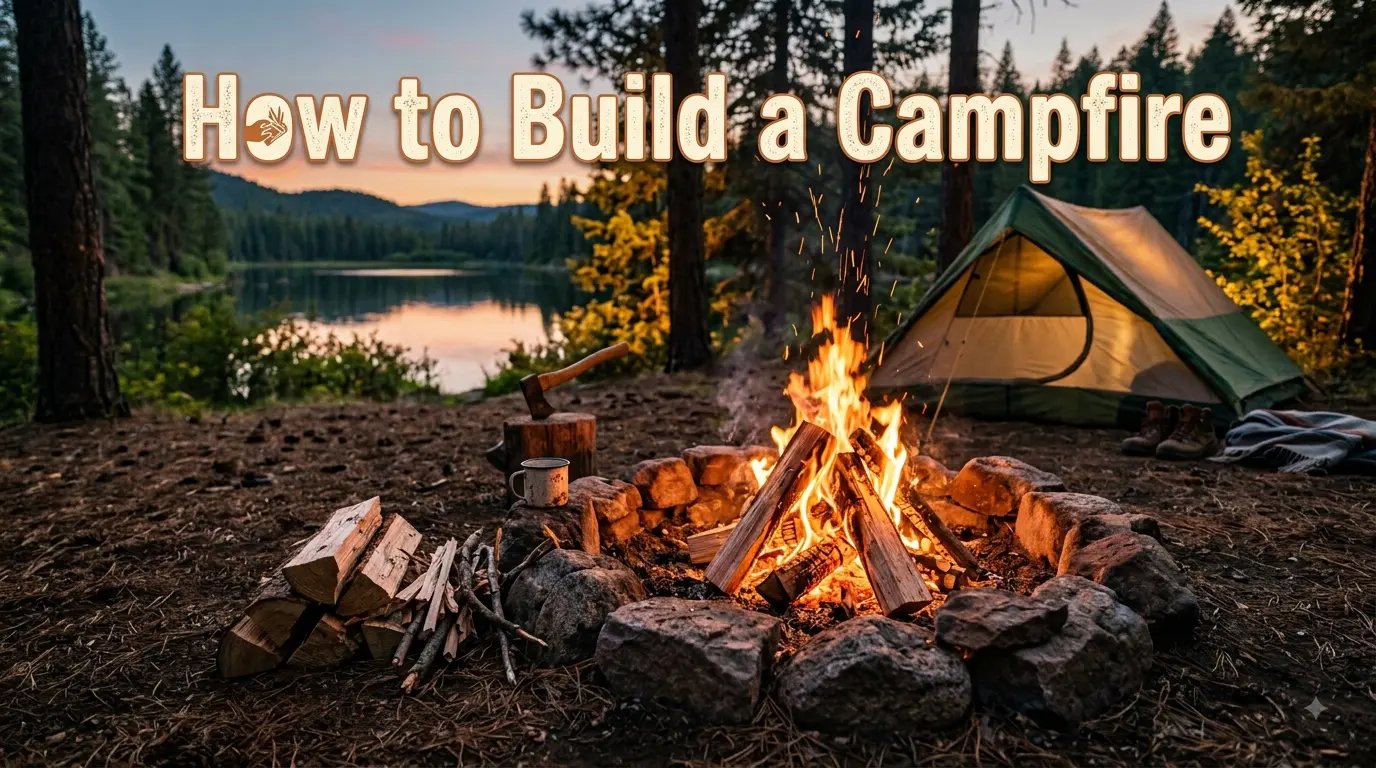
To build a campfire, clear a 10-foot circle down to bare mineral soil, then stack your fuel in three stages: a handful of tinder, a bundle of pencil-thin kindling, and split logs on top. Light the tinder, let the kindling catch, and add fuel wood only once you have a steady flame.
That is the whole process in one paragraph. However, knowing how to build a campfire reliably requires a bit more nuance when conditions change. The rest of this guide covers the part most instructions skip: which of the seven fire structures to build for your actual conditions, how to get a fire going when the wood is wet, and how to put it out so it stays out.
So stick with geeks.it.com By the end, you will know exactly how to build a campfire in rain, wind, or damp ground and know precisely which layer to choose before you strike a match.
Key Takeaways
- A campfire needs three fuel stages in order: tinder (catches a spark), kindling (pencil to thumb thickness), and fuel wood (wrist thickness or larger).
- The teepee lay is fastest to light. The log cabin burns longest. The top-down lay needs the least tending, holding steady for about an hour without touching it.
- Seasoned firewood contains under 20 percent moisture. Green wood runs 30 to 50 percent and will smoke heavily instead of burning.
- Softwood ignites fast and burns out fast. Hardwood is harder to light but produces the long-lasting coal bed you want for cooking or overnight warmth.
- A fire is only out when the ashes are cold to the touch. Drown it, stir it, drown it again, then check with your bare hand.
- The National Park Service reports that people cause roughly 85 percent of wildland fires in the United States. Check local fire restrictions before you build anything.
Where should you set up a campfire?
Set up your campfire in an existing fire ring if one is available. If none exists, choose flat ground at least 15 feet from tents, trees, dry grass and overhanging branches, then clear a 10-foot circle down to bare mineral soil.
Mineral soil is the layer of sand, gravel or clay beneath the organic topsoil. It will not burn. Duff, the spongy layer of decomposed leaves and needles above it, absolutely will, and it can smoulder underground for days before surfacing as a wildfire well away from your camp.
Additionally, check what is above you before what is below you. Overhanging branches catch fire from heat alone, without direct flame contact.
Wind direction determines your structure. Note which way it is blowing before you build a campfire, because two of the seven fire lays depend on facing the opening into the wind. On wet ground, lay a platform of green logs or flat stones first, since contact with saturated soil steals enough heat to kill a young fire.
What materials do you need to build a campfire?
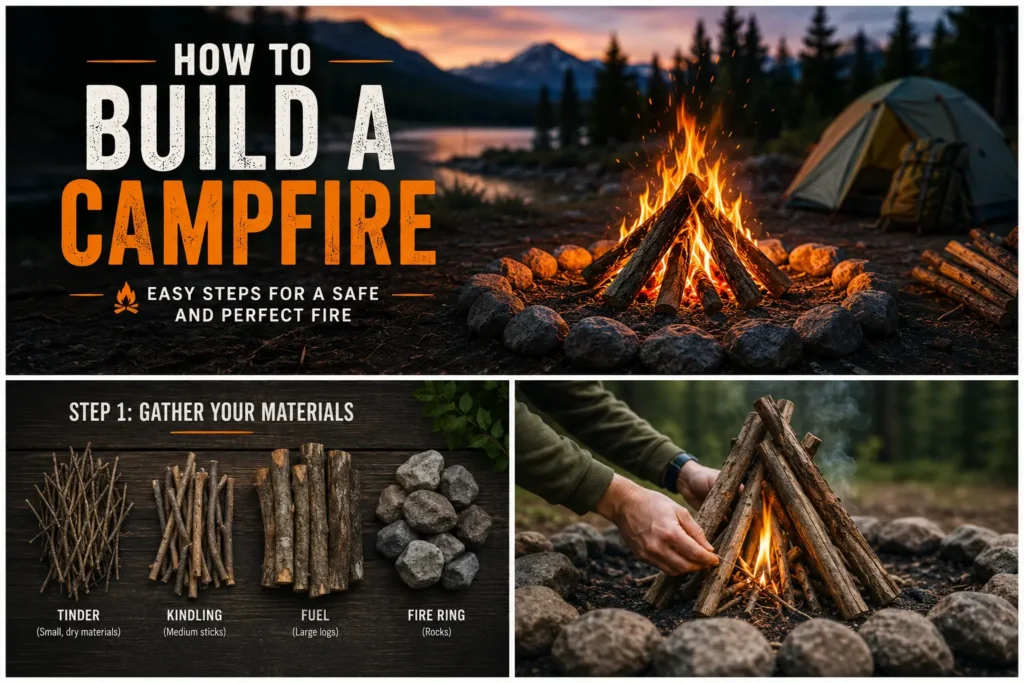
You need three materials in three sizes: tinder, kindling and fuel wood. Skipping a size is the single most common reason a campfire fails.
Tinder is any dry, fine material that catches from a single spark or match flame. It burns hot and fast, for 30 seconds or less. Its only job is to ignite the kindling.
| Stage | Thickness | Examples | Burn time |
| Tinder | Thread to matchstick | Birch bark, dry grass, char cloth, cotton ball with petroleum jelly, fatwood shavings, dryer lint | 10 to 60 seconds |
| Kindling | Pencil to thumb | Split softwood, dead twigs snapped from standing branches, feather sticks | 2 to 10 minutes |
| Fuel wood | Wrist to forearm | Split seasoned hardwood or softwood logs | 20 to 60 minutes |
Gather roughly twice what you think you need. A double handful of tinder, a full armload of kindling, and eight to ten split logs will start a fire and hold it for the first hour.
Collect dead wood from standing trees rather than the ground, which absorbs moisture even in dry weather. A branch that snaps cleanly is dry enough. One that bends is still green. Fatwood is worth carrying separately: resin-saturated pine heartwood that lights soaking wet, where one fist-sized chunk starts a dozen fires.
How do you build a campfire step by step?
Follow these eight steps in order. Each one has a specific action, and the order matters more than the technique.
- Clear and prepare the site. Scrape a 10-foot circle down to mineral soil. Ring the fire area with stones if no fire ring exists.
- Sort your materials into three piles. Tinder, kindling and fuel wood, kept separate and within arm’s reach of where you will sit.
- Place the tinder bundle in the centre. Make it loose and airy, roughly the size of a grapefruit. Compressed tinder suffocates.
- Build your kindling structure over the tinder. Choose your lay from the comparison in the next section. Leave gaps for airflow on every side.
- Light the tinder from the upwind side. Hold the flame low and underneath, so heat rises into the bundle rather than away from it.
- Wait for the kindling to catch fully. This takes two to four minutes. Do not add fuel wood before the kindling is burning on its own.
- Add fuel wood one piece at a time. Place, do not drop. Dropping a log collapses the structure and cuts off the airflow keeping it alive.
- Establish a coal bed before you settle in. Twenty to thirty minutes of steady burning produces the glowing base that makes a fire self-sustaining.
The most frequent error sits at step 6. People add a large log the moment they see flame, the log absorbs the heat that was building, and the fire dies four minutes later.
Which campfire structure should you build?
Choose your fire lay based on conditions and purpose, not habit. The teepee is the default most people learn, and it is the wrong choice in high wind or for cooking.
| Fire lay | Best for | Lights | Burns | Weakness |
| Teepee | Fast heat, damp wood | Fastest | 20 to 30 min | Collapses; needs constant tending |
| Log cabin | Long steady burn, cooking | Moderate | 45 to 90 min | Slower to establish |
| Lean-to | High wind | Moderate | 30 to 45 min | Uneven heat |
| Top-down | Low tending, clean burn | Slowest | 60+ min untouched | Needs genuinely dry wood |
| Star | Fuel conservation | Moderate | Hours | Low heat output |
| Swedish torch | Cooking on a flat surface | Slow | 2 to 4 hours | Needs one large seasoned log |
| Dakota fire hole | Wind, stealth, low impact | Moderate | Sustained | Requires digging |
Teepee
Stand kindling upright in a cone around the tinder bundle, leaning the tops together. The shape creates a chimney effect, drawing air up through the base and concentrating heat at the centre. That makes it the fastest lay to light and the most forgiving with marginal wood. It also collapses as it burns, so expect to rebuild it once or twice.
Log cabin
Lay two logs parallel, then two more across them at right angles, stacking three or four levels with tinder and kindling in the middle. The structure is stable and self-feeding as the upper levels drop into the coals. Build this one when you want to cook or when you want to stop tending the fire and start talking to people.
Lean-to
Drive a thick stick into the ground at a 30-degree angle, then lean kindling against it in a row with tinder underneath. The angled stick shields the flame from wind. Point the open side into the breeze so air feeds the fire instead of flattening it. This is the lay for an exposed ridge or a windy beach.
Top-down (upside down)
Stack your largest logs on the bottom, then progressively smaller wood, with kindling and tinder on top. Light from above. The fire burns downward, preheating and drying each layer before it reaches it. Smoke output drops noticeably because the rising gases pass back through the flame.
A well-built top-down fire holds for over an hour with no tending, which is why it is the right choice on a cold night when you would rather not get up.
Star
Arrange five logs like spokes on a wheel with a small fire at the hub, pushing them inward as the ends burn. The lay uses very little wood and runs for hours, but heat output stays low. Treat it as a long-duration fire rather than a warming one.
Swedish fire torch
Cut three or four vertical slots most of the way down a dry log 12 to 18 inches tall, then light it from the top. The slots act as a chimney and the log burns from the inside out, giving a stable flat cooking surface for two to four hours. Seasoned wood and a saw are both required.
Dakota fire hole
Dig a chamber 12 inches deep and 10 inches across, then a second angled tunnel joining it from the upwind side. Air draws through the tunnel and feeds the fire from below. It burns hot, shows little visible flame, resists wind, and leaves almost no surface trace once filled in. Many managed sites prohibit digging, so check first.
How to Build a Campfire without Lighter Fluid?
Light the tinder directly with a match, lighter, or ferrocerium rod, held low and underneath the bundle. Lighter fluid is unnecessary for any fire built with correctly sorted materials, and it burns off in seconds without ever heating the kindling.
Knowing how to start a campfire without accelerants matters most when conditions are poor, because accelerants fail exactly when you need help.
A ferrocerium rod is a metal alloy that throws sparks at roughly 3,000°C when scraped with a steel edge. It works soaking wet, which matches and lighters do not. Scrape it slowly and firmly with the spine of a knife, aiming sparks into the centre of the tinder rather than at its surface.
Three ignition methods, ranked by reliability:
- Ferro rod plus dry tinder. Works wet, works cold, works at altitude. Requires fine tinder to catch the spark.
- Storm matches. Burn through wind and light rain. Finite supply.
- Butane lighter. Easiest in fair conditions. Fails below freezing and fails when wet.
Never use gasoline. The vapour ignites before the liquid does and flashes back toward the container in your hand.
What wood is best for a campfire?
Seasoned hardwood is the best campfire wood. Oak, hickory, maple, ash and birch burn long and produce a dense coal bed. Softwoods like pine and cedar light quickly but burn out fast and throw sparks.
Seasoned wood is timber dried to below 20 percent moisture content, usually by stacking it under cover for six to twelve months. Green wood holds 30 to 50 percent moisture. It hisses, smokes, and refuses to sustain flame because the fire spends its energy boiling water instead of producing heat.
Test wood in the field by knocking two pieces together. Seasoned wood gives a sharp crack. Green wood gives a dull thud. Check the ends too: seasoned logs show radial cracks spreading from the center.
Use both types deliberately. Split softwood makes excellent kindling because it ignites at lower temperatures. Hardwood goes on afterwards, once you have flame to work with.
Avoid treated lumber, painted wood, plywood, and driftwood. All four release toxic compounds when burned.
One rule surprises most people: do not transport firewood more than 50 miles. Invasive insects including the emerald ash borer travel inside cut logs and have destroyed millions of North American trees this way. Buy it where you burn it.
How to Build a Campfire in the Rain?
Build a campfire in wet conditions by splitting your wood to reach the dry interior, constructing a raised platform so the fire never touches wet ground, and using a teepee lay to concentrate heat on the damp fuel.
Rain does not soak through a log. It wets the outer half-inch. Split a wet log and the wood inside is dry, which means a hatchet or a sturdy knife is the difference between a fire and a cold night.
Work through these five adjustments:
- Build a platform. Lay green logs or flat stones as a base so your fire sits above the saturated ground.
- Split everything. Take kindling and fuel wood from the interior of split pieces, not from the wet surface.
- Make feather sticks. Shave curls into a dry stick without detaching them, creating a fuzzy fibrous surface that catches from a spark.
- Use a teepee lay. The chimney effect drives the most heat into damp fuel.
- Shelter the ignition point. Use your body, a pack or a tarp positioned safely overhead to block rain during the critical first three minutes.
Carry backup tinder that ignores weather. Cotton balls worked with petroleum jelly burn two to three minutes each and weigh almost nothing. Standing dead wood also stays drier than anything on the ground, so look for dead branches still attached to living trees.
Why does your campfire keep going out?
A campfire dies for one of four reasons: not enough airflow, wet or green wood, fuel added too early, or the sizes skipped a stage. Diagnose which one before you rebuild.
Fire needs three inputs simultaneously: heat, fuel and oxygen. Remove any one and combustion stops. The fire triangle explains nearly every failure you will encounter.
| Symptom | Likely cause | Fix |
| Heavy white smoke, little flame | Wet or green wood | Split to the dry interior; add dry kindling |
| Flame dies within a minute of lighting | Tinder packed too tight | Loosen the bundle; add air gaps |
| Fire dies right after adding a log | Fuel added before the coal bed formed | Wait 20 minutes; add smaller pieces first |
| Flames flare then vanish | Kindling stage skipped | Rebuild with pencil-thick material between tinder and logs |
| Fire smoulders and will not build | Structure collapsed, blocking airflow | Rebuild the lay; keep gaps on all sides |
Blowing on a struggling fire works, but aim low and steady at the base rather than at the flames. Short sharp breaths scatter embers and cool the fire faster than they feed it.
How to build a campfire that burning all night?
Keep a fire going overnight by building a deep coal bed first, then banking it with large hardwood logs placed close together and covered with a layer of ash. A properly banked fire holds usable coals for six to eight hours.
Coals sustain a fire. Flames do not. Burn hardwood steadily for 60 to 90 minutes before you attempt to bank, so you have a bed of embers three to four inches deep.
To bank the fire, place two or three of your largest split logs directly onto the coals with their flat faces almost touching. Restricted airflow between them slows combustion dramatically. Rake ash over the top to insulate the bed and slow oxygen further.
In the morning, scrape back the ash, add fine kindling to the exposed coals, and blow gently at the base. A well-banked fire relights in under two minutes with no matches.
Banking a fire and going to sleep is appropriate at a monitored, established site in damp conditions. It is not appropriate on a dry, windy night anywhere, and never under an active fire restriction.
How do you put out a campfire properly?
Put out a campfire by drowning it with water, stirring the ashes thoroughly, and drowning it a second time. The fire is out only when you can hold your bare hand in the ashes and feel no heat.
The U.S. Forest Service standard is straightforward: cold to the touch. Not “looks out.” Not “stopped smoking.” Cold.
Follow this sequence:
- Stop adding fuel 45 minutes before you plan to leave. Let the wood burn down to ash on its own.
- Pour water slowly over the entire fire area. Expect steam and a loud hiss.
- Stir the ashes with a stick or shovel. Turn everything over. Buried embers survive the first pour every time.
- Pour water again, covering the coals, the ash, the surrounding soil and any partly burned logs.
- Stir once more, then check with the back of your hand. Hold it just above the ash, then touch. Any warmth means repeat from step 2.
- Scatter cold ashes or dispose of them as the site rules require.
Never bury a fire with soil to extinguish it. Soil insulates rather than cooling, and buried coals can hold enough heat to reignite the following day or to burn someone who walks over the spot.
If you have no water, use dirt or sand mixed thoroughly into the coals, stirring repeatedly until cold. Treat this as an emergency method, not a routine one.
What are the campfire safety rules?
Check local fire restrictions first, keep a water source within arm’s reach at all times, and never leave a burning fire unattended. Fire restrictions change daily during dry seasons and carry real penalties.
The National Park Service reports that people cause roughly 85 percent of wildland fires in the United States. Campfires are among the leading causes.
Core rules:
- Check restrictions before you travel. Call the ranger district, or check the land agency website for current burn bans.
- Keep the fire small. A fire larger than three feet across is harder to control and produces no additional useful warmth.
- Store a water bucket and a shovel beside the fire. Not in the car.
- Never leave the fire unattended, even briefly.
- Keep children and pets three feet back at minimum.
- Do not burn trash, plastic, aerosols or sealed containers. Aerosol cans explode.
- Extinguish completely before sleeping or leaving.
Who this guide is not for. Under an active burn ban, no technique here applies. Use a camp stove. In designated wilderness managed under Leave No Trace principles, consider skipping the fire entirely, since fire rings scar sites for decades and a stove cooks faster. Land clearing and agricultural burning are permitted activities with separate rules this guide does not cover.
Frequently asked questions
How long does it take to build a campfire?
Site preparation and material gathering take 15 to 30 minutes. Actual fire building takes 5 to 10 minutes, and reaching a usable coal bed takes another 20 to 30. Budget an hour from arrival to cooking.
How much firewood do I need for one night?
Plan on 3 to 5 split logs per hour for a moderate fire. A five-hour evening needs 15 to 25 pieces, roughly one large armload, plus a separate armload of kindling.
What is the easiest campfire to build for a beginner?
The teepee. It lights faster than any other lay and tolerates imperfect wood. Its drawback is instability, so expect to rebuild it as it burns down.
Do I need a permit to have a campfire?
Often, yes. Many national forests, state parks and dispersed camping areas require a campfire permit, and requirements tighten during fire season. Check with the managing agency before you travel.
Why is my fire producing so much smoke?
Excess smoke means incomplete combustion, almost always caused by wet or green wood or by insufficient airflow. Split the wood to reach the dry interior and open up the structure.
Is it safe to cook directly over a campfire?
Yes, once the flames have died down to coals. Cook over embers rather than open flame, which produces uneven heat and coats food in soot. A log cabin lay or a Swedish fire torch gives the most stable cooking surface.