
HOW MANY WEEKS IN A YEAR?

That leftover day is why some years contain 53 numbered weeks instead of 52. This guide covers How Many Weeks in a year, a leap year and 2026 specifically; how the ISO 8601 numbering system decides when a year gets a 53rd week; and how many of those weeks you actually work. By the end you will be able to calculate the week count for any year yourself.
Key Takeaways
- A common year contains 52 weeks and 1 day (365 ÷ 7 = 52.142857).
- A leap year contains 52 weeks and 2 days (366 ÷ 7 = 52.285714).
- The average Gregorian year is 365.2425 days long, or 52.1775 weeks.
- 2026 has 53 ISO weeks, not 52. ISO week 53 runs from Monday, December 28, 2026 to Sunday, January 3, 2027.
- 53-week years occur 71 times in every 400-year cycle, roughly once every 5.6 years.
- The Gregorian calendar repeats exactly every 400 years, because 146,097 days is precisely 20,871 weeks.
- A typical U.S. work year is about 52.2 weeks of paid time, based on the 2,087-hour standard used by the federal government.
How many weeks are in a year?
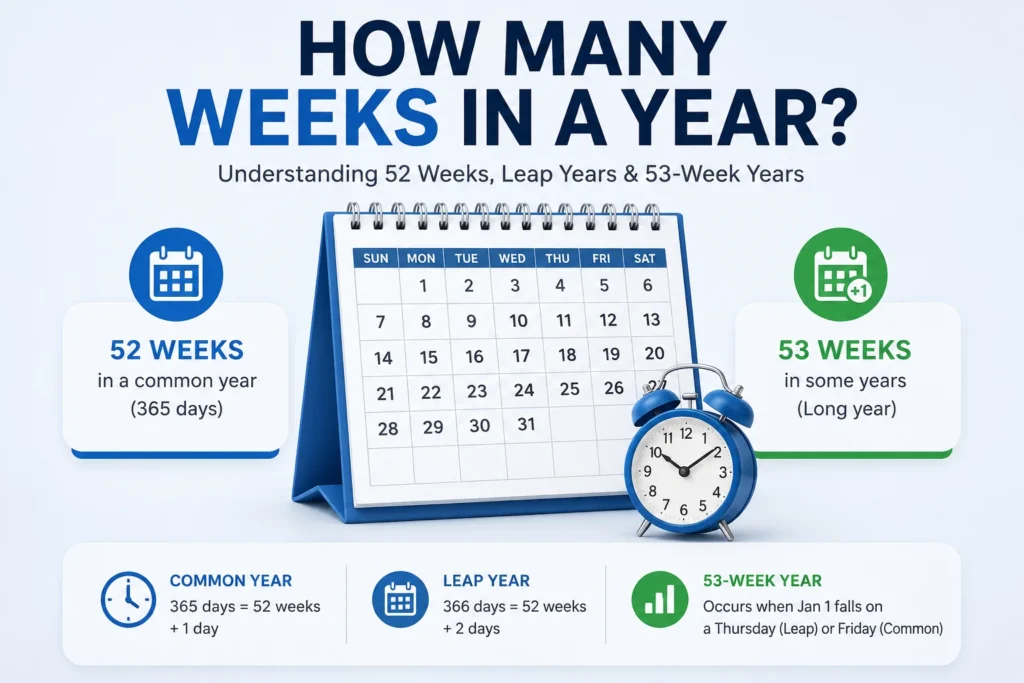
A year has 52 weeks and 1 extra day. The calculation is straightforward: 365 days divided by 7 days per week equals 52.142857 weeks. Since a week cannot be fractional in everyday use, the practical answer is 52 whole weeks with 1 day remaining.
A week is a fixed 7-day period. It does not vary in length, unlike months, which range from 28 to 31 days. This is why weeks divide unevenly into years while months divide evenly into 12.
The remainder matters more than most people expect. That single leftover day is the reason a date shifts forward one weekday each year. If your birthday falls on a Tuesday this year, it lands on a Wednesday next year, and it jumps two weekdays across a leap year.
For rough planning, 52 is accurate enough. For payroll, fiscal reporting or any system that numbers weeks, 52 is sometimes wrong, and the sections below explain when.
Why isn’t a year exactly 52 weeks?
A year is not exactly 52 weeks because 52 weeks equals 364 days, and the Earth takes roughly 365.2425 days to orbit the Sun. The calendar year is one day longer than 52 weeks in a common year and two days longer in a leap year.
The two units were never designed to fit together. The 7-day week has cultural and religious origins with no astronomical basis. The year is astronomical. Nothing forces 7 to divide evenly into 365.
Here is the arithmetic in full:
| Unit | Days | Weeks | Remainder |
| 52 weeks | 364 | 52.00 | — |
| Common year | 365 | 52.142857 | 1 day |
| Leap year | 366 | 52.285714 | 2 days |
| Average Gregorian year | 365.2425 | 52.1775 | 1.2425 days |
The 365.2425 figure comes from the Gregorian leap year rule: a year is a leap year if divisible by 4, except century years, which must be divisible by 400. That is why 2000 was a leap year and 1900 was not, and why 2100 will not be.
How many weeks are in a leap year?
A leap year has 52 weeks and 2 days. Dividing 366 by 7 gives 52.285714 weeks, so two days remain after 52 complete weeks rather than one.
The extra day is February 29, added roughly every four years to keep the calendar aligned with the solar year. Without it, the calendar would drift out of step with the seasons by about 24 days per century.
That second leftover day has a visible effect. Across a leap year, a fixed date advances two weekdays instead of one. March 1, 2024 was a Friday. March 1, 2025 was a Saturday. Because 2024 was a leap year, dates before February 29 shifted differently from dates after it.
Leap years also make a 53-week year slightly more likely, since two spare days give the calendar two chances to trigger an extra ISO week rather than one.
Recent and upcoming leap years: 2020, 2024, 2028, 2032, 2036.
How many weeks are in 2026?
2026 has 52 weeks and 1 day as a calendar year, and 53 weeks under the ISO 8601 numbering system. It is a common year of 365 days that begins on a Thursday, which is the exact condition that produces a 53rd ISO week.
ISO week 53 of 2026 runs from Monday, December 28, 2026 through Sunday, January 3, 2027. Those final three days of the week fall in 2027 but belong to ISO year 2026.
This matters for anyone running weekly reporting in 2026. A dashboard hard-coded to 52 weeks will drop a week of data. A payroll system that numbers weeks will show a week 53 that some downstream tools do not expect.
| Year | Days | Calendar weeks | ISO weeks |
| 2024 | 366 | 52 weeks 2 days | 52 |
| 2025 | 365 | 52 weeks 1 day | 52 |
| 2026 | 365 | 52 weeks 1 day | 53 |
| 2027 | 365 | 52 weeks 1 day | 52 |
| 2028 | 366 | 52 weeks 2 days | 52 |
| 2029 | 365 | 52 weeks 1 day | 52 |
| 2030 | 365 | 52 weeks 1 day | 52 |
The next 53-week years after 2026 are 2032 and 2037.
What is a 53-week year and how often does it happen?
A 53-week year is a year that contains 53 numbered weeks under ISO 8601 instead of the usual 52. It happens 71 times in every 400-year cycle, which averages out to roughly once every 5.6 years.
Two conditions produce one:
- A common year that starts on a Thursday.
- A leap year that starts on a Wednesday or a Thursday.
Both conditions push enough days into the numbering system to require an extra week. 2026 meets the first condition. 2032 meets the second.
The pattern is irregular, not evenly spaced. Gaps between 53-week years run 5, 6 or 11 years. There is no simple every-nth-year shortcut, which is why hard-coding the interval is a common and costly mistake in scheduling software.
Retail and finance feel this most. The 4-5-4 retail calendar published by the National Retail Federation divides the year into quarters of 4, 5 and 4 weeks, totalling 52 weeks, and inserts a 53rd week periodically to stay aligned with the actual calendar. Retailers reporting a 53-week fiscal year show inflated annual revenue against the prior 52-week year, which is why earnings reports often state comparable figures on a 52-week basis.
How do ISO 8601 week numbers work?
ISO 8601 defines a week as running Monday through Sunday, and defines week 1 as the week containing the first Thursday of January. An equivalent and easier rule: week 1 is the week containing January 4.
ISO 8601 is the international standard for date and time representation, published by the International Organization for Standardization. Most of Europe, most enterprise software and most database systems use it. The United States commonly uses a different convention where weeks start on Sunday.
Three consequences follow from the Thursday rule:
- Week 1 can begin in December. ISO week 1 of 2026 started on Monday, December 29, 2025.
- Early January dates can belong to the previous ISO year. January 1, 2027 falls inside ISO week 53 of 2026.
- The ISO year and the calendar year are different fields. A correct week reference is written as year-week, such as 2026-W53.
This is where reporting breaks. In Microsoft Excel, the WEEKNUM function defaults to a non-ISO system that counts January 1 as week 1 regardless of weekday. ISOWEEKNUM returns the standard value. The two disagree in most years. In Python, date.isocalendar() returns the ISO year, week and weekday correctly, which is the reliable choice when automating date calculations in scripts.
If a payroll export and a BI dashboard disagree about which week a January transaction belongs to, this rule is almost always the cause.
How many work weeks are in a year?
A full-time U.S. work year is approximately 52.2 weeks of paid time before leave is deducted. The U.S. Office of Personnel Management uses a standard of 2,087 work hours per year for federal pay calculations, which divides by 40 to give 52.175 weeks.
The 2,087 figure is not arbitrary. It is the average across a 28-year cycle, accounting for the varying number of weekdays caused by leap years and the day-of-week drift described earlier. Using a flat 2,080 hours (52 × 40) understates the year slightly.
Actual worked weeks are lower once time off is subtracted:
| Deduction | Typical U.S. amount | Weeks removed |
| Federal holidays | 11 days | 2.2 |
| Paid vacation (varies by employer) | 10 to 15 days | 2.0 to 3.0 |
| Sick leave (varies by employer) | 5 to 10 days | 1.0 to 2.0 |
After typical deductions, many salaried U.S. employees work closer to 45 to 47 weeks per year. Contractors and freelancers should use this figure, not 52, when setting rates. Billing at an assumed 52 weeks and then taking three weeks off produces a 6% shortfall against target income.
[NEEDS EXPERIENCE INPUT: insert your own contractor rate calculation, a real annual invoice total, or a screenshot of a rate model here. This section is the highest-value place on the page for first-hand proof.]
How many working days are in a year?
A common year contains 260 or 261 weekdays, and a leap year contains 260 to 262. The exact count depends on which weekday January 1 falls on.
The base calculation: 52 complete weeks contain 260 weekdays and 104 weekend days. The leftover day or days then determine the total. If the extra day is a weekday, the year has 261. If it falls on a weekend, the year stays at 260.
2026 has 261 weekdays. The year begins and ends on a Thursday, giving it 53 Thursdays and 52 of every other weekday.
Subtract federal holidays to reach actual working days. With 11 federal holidays, 2026 gives roughly 250 working days, though the precise number depends on how many holidays fall on weekends and whether your employer observes the adjusted weekday. [INSERT STAT — verify exact 2026 federal holiday weekday distribution against the OPM published schedule]
For anyone building a study or project schedule around this, allocating fixed weekly blocks tends to hold up better than daily targets across a full year. The same logic applies to balancing weekly commitments against a long calendar.
How do you calculate the number of weeks between two dates?
Divide the total number of days between the two dates by 7. The whole-number result is the number of complete weeks, and the remainder is the number of extra days.
Follow these five steps:
- Count the total days between the dates. Include leap days if February 29 falls inside the range.
- Divide the total by 7.
- Take the whole number. This is your count of complete weeks.
- Take the remainder. This is your leftover days. A remainder of 3 means “and 3 days.”
- Decide whether to round. For deadlines, round down. For provisioning or capacity planning, round up.
Worked example. From January 1, 2026 to December 31, 2026 is 365 days. 365 ÷ 7 = 52 remainder 1. That is 52 weeks and 1 day.
Second example. From March 1, 2026 to September 1, 2026 is 184 days. 184 ÷ 7 = 26 remainder 2. That is 26 weeks and 2 days.
For spreadsheet users, =(END_DATE – START_DATE)/7 returns the decimal weeks, and wrapping it in ROUNDDOWN gives complete weeks. Do not use WEEKNUM subtraction to find a duration, because it fails across year boundaries.
When does the 52-week answer break down?
Use 52 for rough planning. Do not use it for anything that numbers, bills or reconciles weeks.
52 works fine for:
- Estimating an annual figure from a weekly one
- Personal goal setting and habit tracking
- Casual scheduling and rough project timelines
- Converting a weekly rate to an annual rate at low precision
52 will cause errors in:
- Payroll systems, where biweekly pay produces 26 pay periods in most years and 27 in some
- Fiscal reporting on a 52/53-week calendar, where a 53rd week inflates annual comparisons
- Weekly BI dashboards that hard-code an array of 52 buckets
- Contract terms that specify a number of weeks rather than a date range
- Subscription billing that renews on a weekly cycle across a year boundary
The 27-paycheck year is the most common real-world consequence. Biweekly pay means 26 periods in a 364-day cycle, so the accumulated leftover days eventually add a 27th payday. Employers handle this in different ways, and salaried staff sometimes see a slightly reduced per-period amount as a result.
Who this page is not for: if you need a legally binding week count for a specific contract, statute or fiscal filing, confirm the definition used in that document. Contracts sometimes define “week” as a rolling 7-day period from a start date rather than a Monday-to-Sunday ISO week, and the two produce different answers.
Quick reference: a year in other units
| Unit | Common year (365 days) | Leap year (366 days) |
| Weeks | 52 weeks 1 day | 52 weeks 2 days |
| Weeks (decimal) | 52.142857 | 52.285714 |
| Days | 365 | 366 |
| Hours | 8,760 | 8,784 |
| Minutes | 525,600 | 527,040 |
| Seconds | 31,536,000 | 31,622,400 |
| Weekdays | 260 or 261 | 260 to 262 |
| Weekend days | 104 or 105 | 104 to 106 |
| Fortnights | 26 weeks 1 day | 26 weeks 2 days |
The Gregorian calendar’s most useful property sits underneath this table. A 400-year cycle contains 303 common years and 97 leap years, totalling 146,097 days. Divide that by 7 and the result is 20,871 with no remainder. The calendar therefore repeats exactly every 400 years, weekdays included. January 1, 2026 falls on a Thursday, and January 1, 2426 will also fall on a Thursday.
Frequently asked questions
Is a year exactly 52 weeks?
No. A year is 52 weeks and 1 day, or 52 weeks and 2 days in a leap year. Exactly 52 weeks equals 364 days, one day short of a standard calendar year.
How many weeks are in 2026?
2026 has 52 weeks and 1 day as a calendar year, but 53 numbered weeks under ISO 8601, because it begins on a Thursday. ISO week 53 runs December 28, 2026 to January 3, 2027.
How many weeks are in half a year?
Half a year is 26 weeks and either half a day or one day, depending on leap year status. Six calendar months range from 181 to 184 days, so the exact figure depends on which months you count.
How many weeks are in a year and a half?
Eighteen months is approximately 78 weeks. Precisely, 547 days divided by 7 gives 78 weeks and 1 day, though the total varies by 1 to 2 days depending on the months and leap years involved.
Why does my calendar show 53 weeks?
Your calendar is using ISO 8601 numbering and the year meets the 53-week condition. This happens when a common year starts on a Thursday, or a leap year starts on a Wednesday or Thursday.
How many weeks are left in the year?
Count the days from today to December 31 and divide by 7. As a shortcut, subtract the current ISO week number from 52, or from 53 in a 53-week year such as 2026.
Do all countries number weeks the same way?
No. ISO 8601 (Monday start, Thursday rule) is standard across Europe and in most enterprise software. The United States and Canada commonly use a Sunday-start convention where January 1 always falls in week 1.
How many weeks are in a school year?
A typical U.S. school year runs about 36 weeks, based on the 180 instructional days required by most states. The figure varies by state and district. [INSERT STAT—verify current state-level instructional day requests.