GPT-5.6 Sol vs Terra vs Luna: Specs, Pricing, and Which One to Use
Last updated: July 31, 2026 | Verified against OpenAI’s official model pages
The difference between GPT-5.6 Sol vs Terra vs Luna is price and reasoning depth, not context size or features. All three share an identical 1,050,000-token context window, 128,000 max output tokens, and a February 16, 2026 knowledge cutoff. What separates them is cost: Sol runs $5 input / $30 output per million tokens, Terra $2.50 / $15, and Luna $1 / $6. Sol is built for frontier reasoning and long-horizon agentic work, Terra for everyday production workloads, and Luna for high-volume, cost-sensitive tasks. The generic gpt-5.6 alias routes to Sol which matters more than it sounds, because it is the most expensive tier.
This guide covers the verified specs for each tier, where the real cost drivers hide, and a practical way to pick the right one.
How We Verified These Specs
Every number below was pulled from OpenAI’s official model documentation pages on July 31, 2026, not from secondary coverage.
That distinction turned out to matter. While researching this article we found several widely-shared posts listing GPT-5.6 Luna at $0.20 input / $1.20 output. OpenAI’s own model page for Luna lists $1.00 input / $6.00 output. The likely source of the error is the comparison widget on OpenAI’s page, which shows GPT-5.6 Terra at $2.50, GPT-5.6 Luna at $1.00, and GPT-5.4 nano at $0.20 side by side — a different model from an older generation. Anyone skimming that widget could easily attribute nano’s price to Luna.
If you are budgeting off a figure you read elsewhere, this is worth double-checking. A 5x pricing error compounds fast at volume.
Where third-party benchmark results appear in this article, they are labelled as such. OpenAI does not publish all of the benchmark comparisons circulating online.
GPT-5.6 Sol vs Terra vs Luna: The Specs Compared
Here is what OpenAI’s documentation lists for all three tiers:
| Specification | Sol | Terra | Luna |
| API model ID | gpt-5.6-sol | gpt-5.6-terra | gpt-5.6-luna |
| Input price (per 1M tokens) | $5.00 | $2.50 | $1.00 |
| Output price (per 1M tokens) | $30.00 | $15.00 | $6.00 |
| Cached input | 90% discount | 90% discount | $0.10 |
| Context window | 1,050,000 | 1,050,000 | 1,050,000 |
| Max output tokens | 128,000 | 128,000 | 128,000 |
| Knowledge cutoff | Feb 16, 2026 | Feb 16, 2026 | Feb 16, 2026 |
| Reasoning tokens | Supported | Supported | Supported |
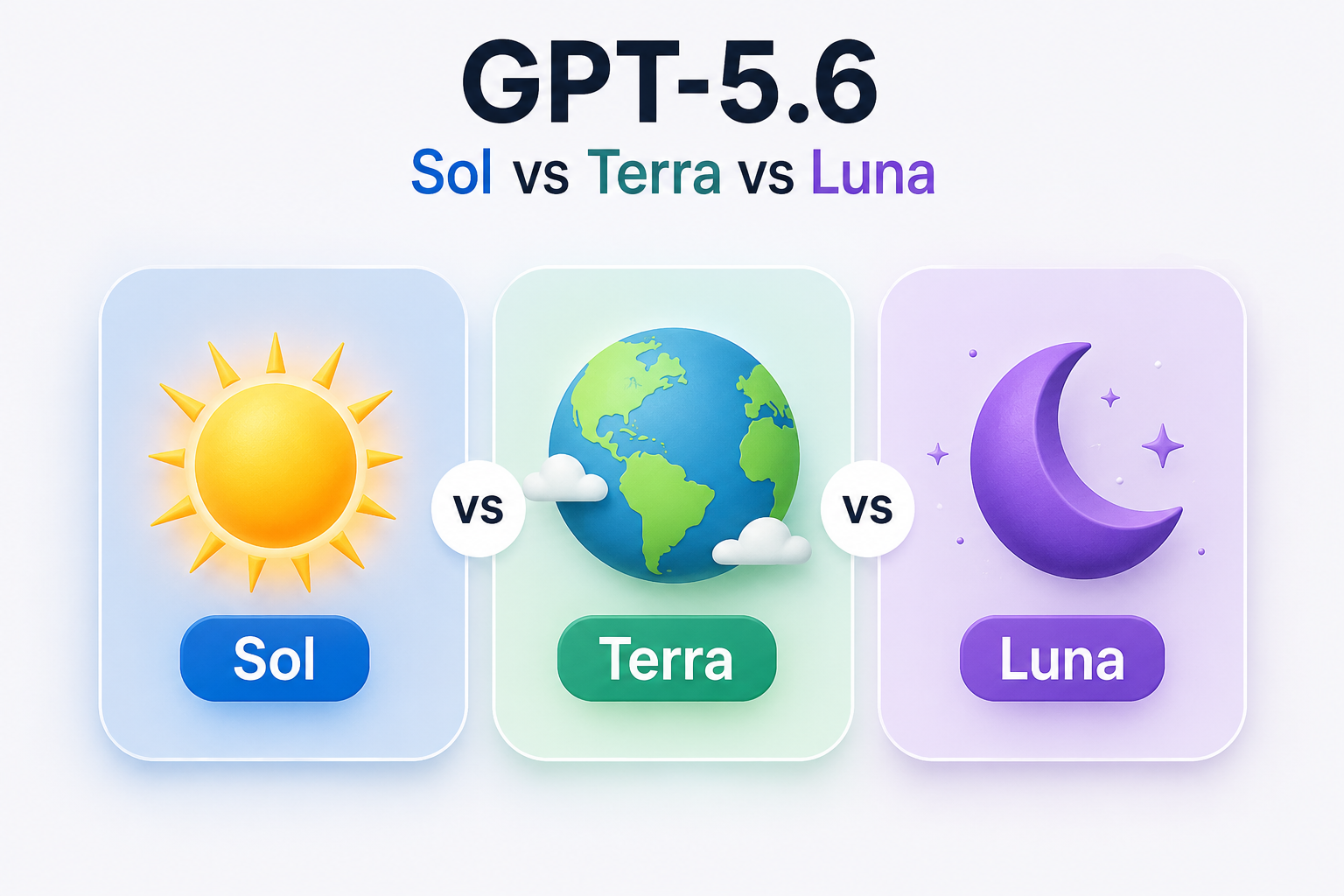
The naming maps to the sun, earth, and moon and to relative size. OpenAI positions Sol as the frontier flagship, Terra as the balanced everyday model, and Luna as the fast, cheap tier. Luna roughly corresponds to the nano tier in earlier GPT-5 families.
The key insight: since context window, output limit, and knowledge cutoff are identical across all three, “which model has the bigger context window” is not a real question here. Your decision is purely about how much reasoning quality you need and what you are willing to pay for it.
What Features Do All Three Models Share?
This is where GPT-5.6 differs from earlier generations, where capability often varied by tier. OpenAI’s model pages list the same tool support across Sol, Terra, and Luna:
Tools supported (via the Responses API): web search, file search, image generation, code interpreter, hosted shell, apply patch, skills, computer use, MCP, and tool search.
Features supported: streaming, function calling, and structured outputs.
Not supported on any tier: fine-tuning. If your workflow depends on a custom fine-tuned model, GPT-5.6 is not currently an option — a constraint worth planning around, particularly if you are migrating away from a fine-tuned GPT-4 model before its shutdown date. (→ internal link: OpenAI API Shutdown Dates 2026: Complete List and What to Do)
Modalities: all three accept text and image input, and produce text output. Audio and video are not supported — those workloads need OpenAI’s dedicated audio and realtime models.
Where the Real Costs Hide
The headline per-token rates are only part of the bill. Three details change your actual spend significantly:
Output tokens cost 6x more than input
Across every tier, output is priced at six times input. Sol is $5 in, $30 out. Terra is $2.50 in, $15 out. Luna is $1 in, $6 out. For applications that generate long responses, output volume drives your bill far more than prompt length does. Trimming verbose outputs is usually a bigger lever than trimming prompts.
Long-context requests are billed at a premium
The 1.05M context window is real, but it is not priced flat. Requests containing more than 272,000 input tokens are billed at 2x the input rate and 1.5x the output rate — for the entire request, not just the tokens above the threshold.
That last part is the trap. A request at 271,000 tokens and one at 273,000 tokens are priced very differently, because crossing the line reprices everything. If your workload sits near that boundary, chunking below 272K is worth engineering for.
Prompt caching changes the maths for agents
Cached input reads carry a 90% discount, while cache writes are billed at 1.25x the uncached input rate. For agent workflows that repeatedly send the same system prompt, tool definitions, or document context, this is the single biggest cost lever available. Luna’s cached input rate, for example, drops to $0.10 per million tokens.
The trade-off: caching only pays off when your prefix genuinely repeats. Writing to cache costs more than a plain uncached call, so a workload with constantly changing context will spend more, not less.
Which GPT-5.6 Model Should You Use?
A practical way to frame it: match the tier to the cost of being wrong.
Use Sol when a mistake is expensive. Complex multi-step reasoning, long-horizon agentic tasks, scientific or analytical work, and difficult refactoring in production code. If a wrong answer means a human has to redo the work — or worse, means it ships — the price difference between Sol and Luna is trivial compared to the cost of the error.
Use Terra for everyday production work. Standard application workloads where quality matters but budget is real: content generation, summarisation, moderate coding assistance, customer-facing chat. Terra sits at exactly half Sol’s price, which makes it the natural default for most production traffic.
Use Luna for high-volume, low-stakes work. Classification, routing, tagging, extraction, simple transformations. Tasks where you are running thousands of calls and each individual result matters less than throughput and cost. At $1 input, Luna is 5x cheaper than Sol.
A caveat worth stating: these are starting points, not rules. Accuracy, retry rates, tool-calling behaviour, and downstream human review can easily outweigh the raw token price. A cheaper model that needs two retries and a human check is not cheaper. The only reliable method is to test your actual workload on more than one tier and compare total cost including retries.
Watch the default. The generic gpt-5.6 alias routes to Sol. If you wrote gpt-5.6 in a config expecting a sensible mid-tier default, you are paying flagship rates. Specify the tier explicitly.
How Do the Tiers Perform Against Each Other?
OpenAI has confirmed that all three tiers are distilled from the same base training run, which explains the shared specs and identical tool support.
On third-party benchmark testing, the gap between tiers is narrower than the price gap suggests. Independent testing reported on Terminal-Bench 2.1 has placed Sol around 88.8%, Terra around 84.3%, and Luna around 82.5%. Note these are third-party figures rather than OpenAI-published results, and benchmark performance on a synthetic test does not always predict performance on your specific workload.
The practical reading: a roughly 6-point benchmark gap between Sol and Luna comes with a 5x price difference. For many tasks, Luna or Terra will be entirely sufficient — which is precisely why testing your own workload matters more than reading benchmark tables.
How Do You Access GPT-5.6?
All three tiers became generally available on July 9, 2026 across the API, ChatGPT, and Codex.
Via the API: call gpt-5.6-sol, gpt-5.6-terra, or gpt-5.6-luna directly. Both the Chat Completions and Responses endpoints are supported, though the full tool set requires the Responses API.
Rate limits vary by usage tier. Free-tier accounts do not have access. Paid tiers scale from 500 requests per minute at Tier 1 up to 30,000 at Tier 5, with token-per-minute limits scaling alongside. Your tier increases automatically as your spending and request volume grow.
Snapshots: unlike earlier generations with many dated snapshot IDs, GPT-5.6 currently exposes the tier names directly as both alias and snapshot.
Frequently Asked Questions About GPT-5.6 Sol vs Terra vs Luna
What is the difference between GPT-5.6 Sol, Terra, and Luna? Price and reasoning capability. All three share an identical 1,050,000-token context window, 128,000 max output tokens, and February 16, 2026 knowledge cutoff, and support the same tools and features. Sol is the flagship at $5/$30 per million tokens, Terra the balanced tier at $2.50/$15, and Luna the cost-efficient tier at $1/$6.
Which GPT-5.6 model is cheapest? Luna, at $1.00 per million input tokens and $6.00 per million output tokens. Its cached input rate drops to $0.10 per million. Be aware that some published comparisons incorrectly list Luna at $0.20 — that figure belongs to GPT-5.4 nano, a different model.
Do all GPT-5.6 models have the same context window? Yes. Sol, Terra, and Luna all have a 1,050,000-token context window and a 128,000-token maximum output. Context size is not a differentiator between the tiers.
What does the gpt-5.6 alias point to? Sol, the most expensive tier. If you want Terra or Luna, you must specify the full model ID explicitly.
Can you fine-tune GPT-5.6 models? No. Fine-tuning is not supported on any GPT-5.6 tier. Teams currently running fine-tuned models on older bases should factor this into their migration planning.
When are requests billed at long-context rates? When a request contains more than 272,000 input tokens. At that point input and cached input are billed at 2x and output at 1.5x, applied to the entire request rather than only the excess tokens.
Is GPT-5.6 Sol worth it over Terra? It depends on the cost of an incorrect answer in your workload. Sol is twice Terra’s price for a modest benchmark improvement, so it earns its cost on complex reasoning and agentic tasks where errors are expensive, and is often overkill for routine generation and summarisation.
What replaced the mini and nano naming? OpenAI dropped size-based suffixes in this generation. Terra occupies roughly the position mini held, and Luna roughly the position nano held, in earlier GPT-5 families.