ChatGPT Work vs Claude Cowork: Pricing, Limits, and Which One to Choose
Last updated: July 31, 2026 | Pricing verified against both vendors’ official pages
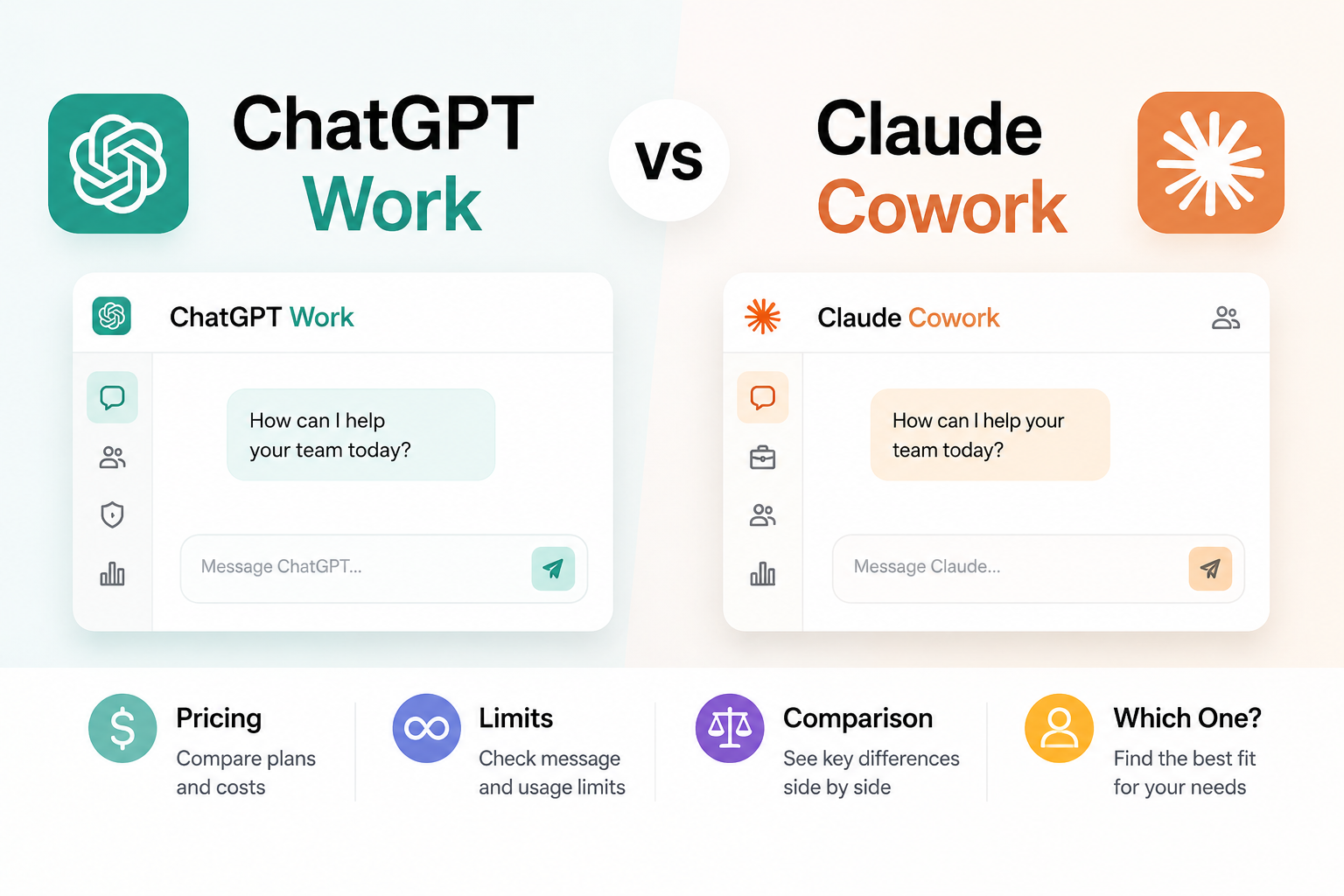
The practical difference in ChatGPT Work vs Claude Cowork is not capability both are autonomous agents that complete multi-step office work across your files and connected apps it is which ecosystem you already live in. Both are bundled into existing subscriptions rather than sold separately, and both start at effectively the same price: $20/month for ChatGPT Plus, $17–20/month for Claude Pro. Neither is available on a free tier. Both meter usage by task complexity rather than by a fixed task count, which means your real cost depends far more on what you ask them to do than on which one you pick.
This comparison covers what each actually includes, where the pricing gets complicated, and how to decide without paying for both.
A Note on Sources
Pricing for both products was verified directly against OpenAI’s and Anthropic’s own pages on July 31, 2026, because secondary coverage of these two products is unusually unreliable right now. Both launched in July 2026, both changed pricing structures in the weeks before, and several widely-shared guides contain figures that were correct for a few weeks and are no longer.
Two specific errors worth knowing about: some guides state that Claude Cowork runs on macOS only, which reflected an earlier release stage; and at least one states that Cowork is available on Claude’s free tier, which Anthropic’s own pricing page contradicts it is listed under Pro’s “Everything in Free, plus” section.
Where the two vendors describe things differently or where public information is genuinely unclear, this article says so rather than picking a number and sounding confident.
What Are ChatGPT Work and Claude Cowork?
Both products answer the same question: what if the AI could do the task instead of telling you how to do it?
ChatGPT Work launched on July 9, 2026 as part of OpenAI’s broader release that also brought the GPT-5.6 model family to ChatGPT, Codex, and the API. It is an autonomous task agent that completes multi-step work spreadsheets, reports, slides across connected apps, holding a task across an extended run rather than answering one prompt at a time. GPT-5.6 Sol vs Terra vs Luna: Specs, Pricing, and Which One to Use)
Claude Cowork is Anthropic’s equivalent: an agent inside the Claude desktop app that works with your files, runs tasks, and returns completed work. It sits alongside chat and Claude Code as a separate mode rather than a separate product.
The shared design idea is delegation. You describe an outcome, the agent works through the steps, and you review the result. That framing matters for evaluating both the right question is not “which gives better answers” but “which can I actually hand work to and trust the output.”
ChatGPT Work vs Claude Cowork: Pricing Compared
What ChatGPT costs
| Plan | Price | Work agent access |
| Free | $0 | No |
| Go | $8/month | No |
| Plus | $20/month | Yes — bundled |
| Pro | $100 or $200/month | Yes — maximum access |
| Business | ~$20/seat annual, $25 monthly | Yes, with admin controls |
| Enterprise | Custom | Yes |
Plus is the entry point for the Work agent. Go at $8 does not include it, and neither does Free. The two Pro tiers buy usage headroom rather than extra features including, at the $200 level, the ability to run the heaviest effort settings inside Work rather than only in Codex.
What Claude costs
| Plan | Price | Cowork access |
| Free | $0 | No |
| Pro | $17/month annual ($200 up front) or $20 monthly | Yes — bundled |
| Max | From $100/month | Yes — 5x or 20x Pro usage |
| Team Standard | $20/seat annual, $25 monthly | Yes |
| Team Premium | $100/seat annual, $125 monthly | Yes — 5x Standard usage |
| Enterprise | $20/seat + usage at API rates | Yes |
Claude Pro includes Cowork alongside Claude Code, Claude Design, and Claude Science. Max does not unlock different capabilities — it buys more usage headroom, in 5x or 20x multiples of Pro.
The honest read on price
At the individual level, these are the same price. $20/month gets you either agent. If you pay annually, Claude Pro works out slightly cheaper at $17/month equivalent, but that is a $36/year difference not a decision-making figure.
Where it diverges is at the top and at the team level. Claude’s Enterprise model is unusual: $20 per seat plus usage billed at API rates, so cost scales with what your team actually runs rather than sitting at a flat premium seat price. Whether that is cheaper depends entirely on usage patterns, and it is genuinely harder to forecast than a flat per-seat fee.
The Usage Limits Nobody Explains Clearly
This is the part that determines your real experience, and both vendors describe it in deliberately non-specific terms.
Neither product gives you a task count. Both meter by complexity. A long document, a large folder, or a multi-step job consumes far more of your allowance than a quick request. This means two people on identical plans can have completely different experiences.
Both draw from a shared pool. On Claude, Cowork usage comes out of the same allowance as chat and Claude Code — one pool covers everything. Anthropic’s limits reset on a rolling five-hour window, with weekly limits on paid plans on top. OpenAI similarly bundles Work and Codex usage rather than metering them separately for individual plans.
Business and team billing has been changing. OpenAI moved workspace agent runs to token-based credit pricing on July 6, 2026, meaning agent usage on Business plans is now billed by input, cached input, and output tokens. If you are budgeting a team rollout on either platform, this is the number that matters more than the seat price — and it is the number most comparison articles skip.
Practical advice: run a two-week pilot on the entry tier before committing a team. Both vendors’ limits are opaque enough that estimating from documentation is unreliable. Measure your actual workload.
Where Each One Has an Edge
Being straight about this: for most everyday office tasks, both are capable, and published head-to-head comparisons tend to reflect the reviewer’s existing workflow more than a real capability gap.
ChatGPT Work is the stronger fit if:
- You are already in the OpenAI ecosystem Codex, custom GPTs, the merged desktop app
- Your team uses ChatGPT Business and has admin tooling set up
- You want the broader consumer feature set around the agent (Sites, Personal Finance preview, and similar)
- You need the widest third-party integration coverage, which OpenAI’s scale tends to favour
Claude Cowork is the stronger fit if:
- You are already paying for Claude Pro or Max Cowork is included at no extra cost
- You want Claude Code and the agent drawing from one subscription
- Your organisation needs a HIPAA-ready offering, available on Anthropic’s Enterprise tier
- You prefer usage-based enterprise billing over flat premium seats
A genuine caveat on capability claims: you will find benchmark comparisons declaring one clearly ahead. Treat these carefully. Agent benchmarks are young, results shift with each model release, and both vendors have shipped multiple model updates in 2026 alone. A benchmark from three months ago may describe a version neither product still runs.
What Neither One Solves
Worth stating plainly, because agent marketing tends to skip it.
Both still need review. An agent that produces a finished spreadsheet has produced a spreadsheet that looks finished. Errors in delegated work are harder to catch than errors in work you did yourself, precisely because you did not follow the reasoning. Build a review step into anything consequential.
Both need access to be useful. Delegating work across your files and connected apps means granting an agent access to those files and apps. That is the trade, and it deserves the same scrutiny as any other tool with broad permissions. (→ internal link: Browse our Online Privacy guides)
Both are moving fast. Pricing, limits, and platform availability for both products have changed repeatedly this year. Anything you read — including this article should be re-checked against the vendor’s own page before you commit budget.
ChatGPT Work vs Claude Cowork: How to Actually Decide
The most useful framing is not feature-by-feature comparison. It is this: which subscription are you already paying for?
If you already have ChatGPT Plus, you already have Work. If you already have Claude Pro, you already have Cowork. In both cases, the agent is bundled there is nothing to buy. Start there, run real work through it for two weeks, and only then evaluate whether the other one would do it better.
If you are paying for neither, the deciding factors in rough order of usefulness:
- Which app do you already have open all day? Ecosystem friction is real and underrated.
- What do you need it to connect to? Check integration coverage for your specific tools before subscribing.
- Are you buying for a team? Then agent billing structure matters more than seat price. Pilot before scaling.
- Do you have compliance requirements? This narrows the field faster than any feature comparison.
Price is genuinely not a differentiator at the individual level. Anyone telling you one is clearly cheaper is comparing different tiers.
Frequently Asked Questions About ChatGPT Work vs Claude Cowork
What is the difference between ChatGPT Work and Claude Cowork? Both are autonomous AI agents that complete multi-step office tasks across your files and connected apps, and both are bundled into existing subscriptions rather than sold separately. The practical differences are ecosystem, integration coverage, and enterprise billing structure rather than core capability.
How much does Claude Cowork cost? Cowork is not sold separately. It is included in Claude Pro ($17/month billed annually, $20 monthly), Max (from $100/month), Team (from $20/seat annually), and Enterprise. It is not available on Claude’s free plan.
How much does ChatGPT Work cost? Work is bundled from ChatGPT Plus ($20/month) upward, including Pro, Business, and Enterprise. It is not available on the Free or Go ($8/month) tiers.
Is either one available for free? No. Both require a paid subscription. Free tiers on both platforms include chat but not the agent, which reflects the compute cost of running autonomous tasks.
Which is cheaper, ChatGPT Work or Claude Cowork? At the individual level they are effectively identical — $20/month either way, with Claude Pro slightly cheaper at $17/month equivalent on annual billing. Meaningful cost differences appear only at team and enterprise scale, where billing structures diverge.
How many tasks can I run per month? Neither vendor publishes a task count, because both meter by task complexity rather than task quantity. A single complex job can consume more allowance than dozens of simple ones. The only reliable way to know your ceiling is to run your actual workload.
Do I need both? Almost certainly not. Both cover the same core use case. Paying for two $20 subscriptions to run the same kind of work is hard to justify unless you have a specific integration that only one supports.
What platforms do they run on? Both have expanded platform support through 2026. Because availability has changed several times this year, check the vendor’s current download page rather than relying on any published guide, including this one.