How Business Students Balance Academic Work and Industry Networking
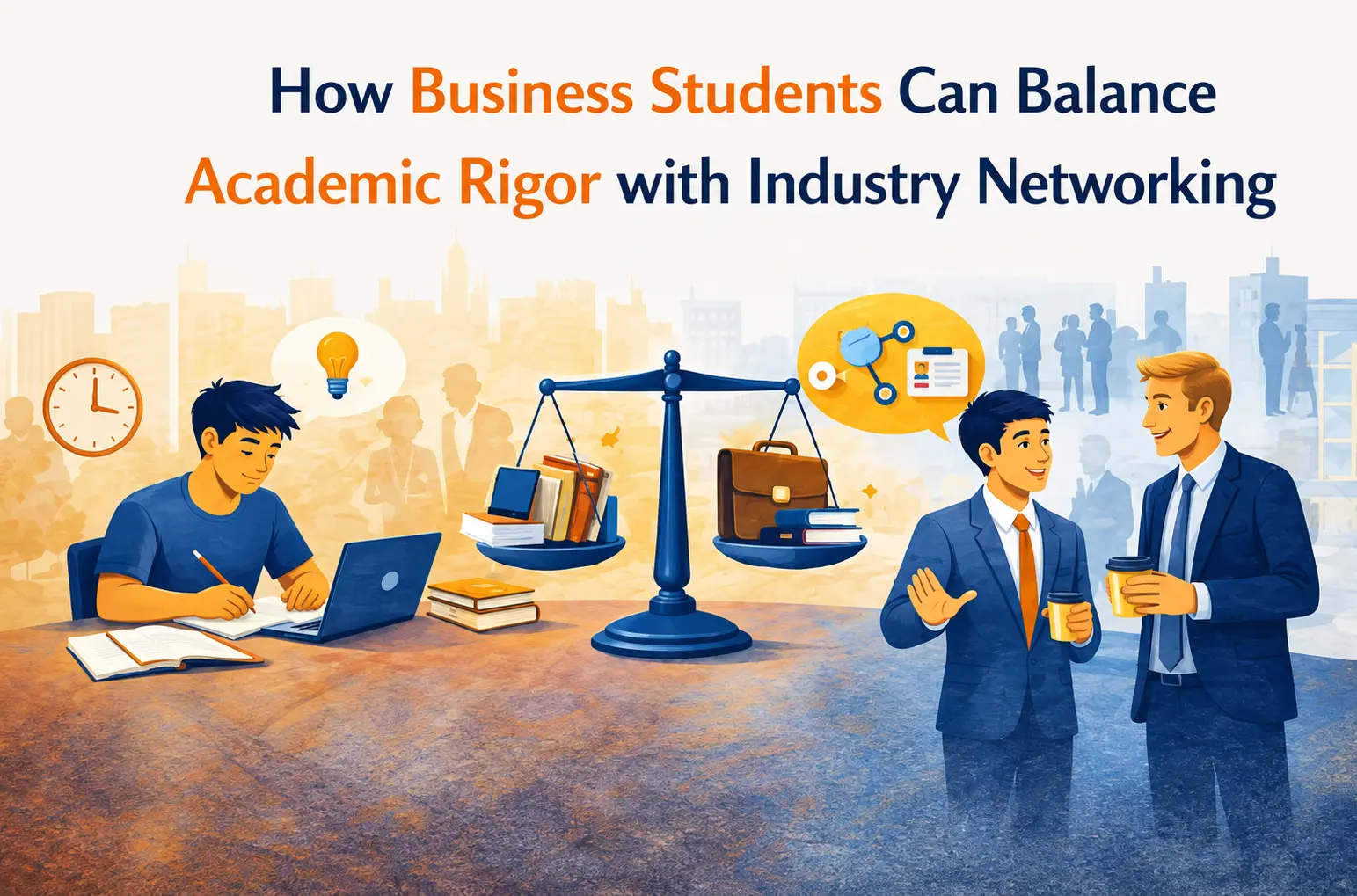
Students balance coursework and networking by giving each a fixed weekly budget rather than letting them compete for the same hours. A workable split is roughly 90 percent of available study time for academics and 4 to 6 hours a week for professional contact. The people who pull this off do not treat networking as an extra task. They route it through work they were already doing.
Key Takeaways
- Networking does not need to compete with your GPA. It needs a protected slot, not a bigger one.
- The most efficient method is to use coursework as the reason for outreach, which turns cold contact into research.
- The often repeated “80 percent of jobs are hidden” figure has no reliable primary source. The underlying idea is supported by research. The number is not.
- Five deep alumni relationships in your target sector beat 500 unfocused connections.
- AI tools help most with retrieval and structure, and least with anything you will be assessed on.
What Is the Real Trade Off Between Coursework and Networking?
A business or technical degree only shows its value in application. You can learn Porter’s Five Forces or a queueing model in a lecture hall, but the way those frameworks bend under real pricing pressure, office politics and regulation is only visible from inside a company.
The problem is that the two halves of your education are measured differently. Your department measures you through graded assessments with hard deadlines. Industry measures you through relationships that have no deadline at all, which is exactly why they get postponed.
That asymmetry is the actual trade off. Not time. Urgency. Academic work always feels more urgent, so it absorbs whatever hours exist. Networking has to be scheduled or it does not happen.
How Many Hours a Week Should a Student Spend Networking?
Four to six hours a week is enough for most students, and it belongs in your low energy hours rather than your sharpest ones.
The 90/10 Split
| Budget | Share of working hours | Typical activities | Best time slot |
|---|---|---|---|
| Academic | About 90 percent | Modelling, problem sets, reading, drafting, exam prep | Mornings, in 90 to 180 minute blocks |
| Professional | About 10 percent | Coffee chats, alumni messages, guest lectures, society events | Late afternoons and early evenings |
The logic is simple. Quantitative coursework demands your best cognitive hours. A twenty minute conversation with an alumnus does not. Putting networking in your morning block spends your sharpest focus on your easiest task, and most students who say networking “ate their week” made exactly that scheduling mistake.
Inside the professional budget, a realistic weekly rhythm looks like this:
- Two short outreach messages, roughly 15 minutes total.
- One live conversation, in person or on a call, roughly 45 minutes including travel.
- One event or guest lecture, roughly 2 hours, not every week.
- Follow ups and note keeping, roughly 30 minutes.
If you want to go deeper on structuring the academic 90 percent, our guides on AI productivity workflows cover the scheduling and automation side in more detail.
Which AI Tools Actually Help With Coursework, and Where Is the Line?
This is where most student advice goes wrong, so it is worth being precise. AI helps enormously with retrieval, structure and comprehension. It should not touch anything you are being assessed on.
Where it genuinely helps:
- Literature scanning. Finding which of forty papers is worth reading, and why. An AI browser handles this far faster than tab hopping. Our comparison of Perplexity Comet and Chrome covers what that workflow actually looks like day to day.
- Explaining a method you already half understand. Ask it to walk you through a derivation step by step, then reproduce the steps yourself without looking. If you cannot, you did not learn it.
- Outlining and structuring your own argument. Give it your thesis and your evidence, and ask where the logic is weak. That is feedback, not authorship.
- Long document work. Summarising a 90 page annual report so you know which section to read properly. If you are choosing a platform for this, the ChatGPT Work and Claude Cowork comparison breaks down the limits and pricing.
Where the line is: anything that produces the submitted artefact. Having AI write your essay, your code submission or your case analysis is academic misconduct at essentially every institution, and detection is not the main risk. The main risk is that you graduate without the skill the degree was supposed to certify, into a market that tests for it in interviews.
A useful rule: delegate the learning support, never the submission. If you could not defend every sentence in a viva, it is not yours.
For self study outside your degree, structured learning platforms remain more reliable than chat based tools for foundational material. Our breakdown of GeeksforGeeks as a learning platform is a reasonable starting point if you are building technical skills alongside coursework.
Browse more tested options in our AI tools section.
How Do You Turn a Class Assignment Into an Industry Contact?
This is the highest leverage move available to a student, because it collapses two obligations into one.
The Project to Contact Method
Step 1: Choose a live problem, not a generic topic. Instead of writing about supply chain resilience in general, write about how a specific mid sized importer handled a specific disruption. Pick a company you would genuinely want to work for.
Step 2: Approach as a researcher, not an applicant. Ask for 10 to 15 minutes to gather primary data for a university project. Name the module. Name your deadline. Ask three specific questions, not “can I pick your brain”.
Step 3: Send something back. When the assignment is graded, send the person a short summary of what you found. Almost everyone skips this step, and it is the step that converts a one off call into a relationship.
Step 4: Log it. Date, name, role, what they said, what you promised. A spreadsheet is enough.
The status shift matters more than the tactic. You are not a student asking for a job. You are a researcher who has done the reading and arrived with questions. Practitioners respond to that at much higher rates, partly because it is flattering and partly because it costs them almost nothing.
It also produces primary data, which most undergraduate submissions lack entirely. It tends to lift the grade and build the network in the same motion.
Is the “80 Percent of Jobs Are Hidden” Statistic True?
No. The figure circulates constantly in career advice content, but it does not trace back to any identifiable study, sample or methodology. Treat it as folklore.
The underlying claim does have real research behind it, and the real research is more useful than the myth.
Mark Granovetter’s 1973 paper “The Strength of Weak Ties” in the American Journal of Sociology found that people more often heard about job opportunities through acquaintances than through close friends. The reason is structural. Close contacts move in the same circles as you and know the same openings you already know about. Acquaintances sit in different clusters and carry different information.
In 2022, Rajkumar and colleagues published a large scale causal test of this idea in Science, using experiments run on LinkedIn. Their results broadly supported the weak ties argument, with the strongest effect coming from moderately weak connections rather than the weakest ones.
The practical translation: your closest classmates are not your best job leads. The alumnus you met once at a panel is. Build outward, not inward.
Who Should Actually Be in Your Network?
Depth beats volume. A useful target structure is the 5-10-20 map:
- 5 mentors. Senior people, ideally 10 or more years ahead of you, in roles you might plausibly hold one day. These take years and cannot be rushed.
- 10 peers. Ambitious students in your cohort or adjacent programmes. These are the people who refer you in five years, when they are inside companies.
- 20 nodes. Working professionals in your target sector at any level. Analysts and associates are often more useful than directors, because they respond faster and remember what the entry process felt like.
Thirty five meaningful contacts is a realistic four year goal, and more than most graduates ever build.
What Should a Follow Up Message Actually Say?
Send it within 24 hours, and make it specific enough that it could not have been sent to anyone else.
- Where you met, in one clause.
- One concrete idea from the conversation, restated in your own words.
- One sentence connecting it to something from your coursework.
- No ask.
The fourth point is the one people get wrong. A first follow up with a request attached reads as transactional. A follow up with no ask reads as interest, and interest is what makes the second message easy to send.
Does Your Digital Footprint Matter as Much as Your Transcript?
For a first screening, often yes. Recruiters check public profiles before they read anything else.
Three things are worth doing:
- Post what you are learning. A short, honest summary of a difficult module is more credible than a motivational quote.
- Comment with substance. A specific question on a practitioner’s post gets noticed. A “great insight” does not.
- Audit what is public. A profile built for recruiters is also a profile built for anyone else. Review your visibility settings, old tagged content and reused passwords before you increase your public surface area. Our online privacy guides cover the practical checks.
How Do You Spot Burnout Before It Costs You a Semester?
Burnout in high performing students rarely announces itself. It shows up as three quiet signals:
- Diminishing returns. An assignment that should take two hours takes five, and the extra three hours do not improve it.
- Social withdrawal. You skip events because you are tired, then tell yourself you were busy.
- Loss of interest. The subjects that made you choose the degree stop being interesting.
If two of these persist for more than a fortnight, drop the professional budget to zero for two weeks rather than cutting sleep. Networking compounds over years and loses almost nothing from a short pause. Academic recovery is much harder.
What Legitimate Support Exists When the Workload Exceeds the Hours?
Every programme has a term where the schedule is arithmetically impossible. Each of these strengthens your work rather than replacing it:
- University writing centre. Structure and argumentation feedback on your own draft. Free almost everywhere and heavily underused.
- Office hours. The fastest way to unstick a modelling or methodology problem. Faculty also become referees later.
- Peer study groups. Especially effective for quantitative modules, where explaining a method out loud reveals whether you actually understand it.
- Subject librarians. Most students never learn what their institution’s databases can do. An hour here can save days.
- Careers service. Underused for the thing it does best, which is alumni introductions.
Frequently Asked Questions
First year. Not to find a job, but because relationships that begin without an ask are far easier to maintain. A first year asking a graduate about module choices is doing legitimate networking.
LinkedIn is efficient for maintenance and poor for initiation. Most strong relationships start with a live conversation and are kept alive online. Use both, in that order.
No. Using AI for the submitted work is academic misconduct at nearly every institution. Using it to find sources, explain concepts or critique your own draft is a different activity and is generally permitted, though you should check your department’s specific policy.
Use the alumni database rather than the events calendar. Alumni respond to shared institutional background even when the careers office is doing nothing. Sector specific professional bodies are the second route.
Yes, and arguably more. A referral moves your application from a screening pile to a human reader. It does not override a formal grade threshold, but many roles have none.
Two is sustainable across a full degree. Ten is sustainable for about three weeks. Consistency matters more than volume, because a network compounds with time rather than headcount.